Walk into any optics aisle or scroll any online store and you’ll face hundreds of rifle scopes, every one of them claiming to be the best. The truth is that there’s no single best rifle scope, there’s only the best rifle scope for your budget, your rifle, and the way you hunt. A scope that’s perfect for an Alberta prairie pronghorn hunt would be the wrong choice for an Ontario bush deer stand, and vice versa.
In this blog post we will tell you how to match the scope to your rifle, and how to match it to your hunt. By the end, you’ll know exactly what to look for and roughly what to pay.
The Short Answer: Match the Scope to Three Things
The best rifle scope for you is the one that matches your budget, your rifle, and your hunting conditions. Get those three right and you’ll have a scope that performs without overspending. Get them wrong and you’ll either be frustrated in the field or paying for features you’ll never use.
In practical terms: spend enough to get clear glass and reliable turrets but not more magnification than your shooting distances require; pair the scope’s magnification and durability to your specific rifle and cartridge; and choose your magnification range and objective size based on whether you hunt tight timber, open country, or mountain terrain. The rest of this guide breaks down each of those three decisions so you can buy with confidence.
The Core Specs That Actually Matter
Before you can choose, you need to understand the handful of specs that genuinely affect performance. Ignore the marketing buzzwords and focus on these.
Magnification: Why More Isn’t Always Better
Magnification is listed as a range like 3-9x or 4-16x, where the first number is the lowest power and the second is the highest. The most common mistake buyers make is chasing maximum magnification. More power narrows your field of view, makes the image dimmer, and amplifies every shake and wobble. For most Canadian hunting, a 3-9x or 4-12x covers everything from a 50-yard bush shot to a 300-yard field edge. Save the 5-25x scopes for genuine long-range work.
| Use Case | Recommended Magnification |
| Bush / timber, close shots | 1-4x to 3-9x |
| All-around big game hunting | 3-9x or 4-12x |
| Open country / longer shots | 4-16x or 4.5-18x |
| Long-range precision | 5-25x or 6-24x |
| Rimfire / .22 training | 2-7x or 3-9x |
Objective Lens Size: Light vs Weight
The objective lens is the front lens, measured in millimetres (40mm, 44mm, 50mm). A larger objective gathers more light, which helps during the low-light dawn and dusk hours when game moves most. But a bigger lens also adds weight and requires higher mounting rings, which can compromise your cheek weld. For most hunting, a 40mm or 44mm objective is the sweet spot. Reserve 50mm and larger for dedicated low-light or long-range setups.
Glass Quality and Light Transmission: Where Your Money Goes
This is the single biggest factor separating a $200 scope from a $1,000 scope. Better glass with fully multi-coated lenses transmits more light, resolves finer detail, and stays sharp edge to edge. You can’t see it on a spec sheet, but you’ll see it the first cold morning when a quality scope shows you a clear, bright deer at last light while a cheap one shows a dim grey blur. When in doubt, prioritize glass quality over magnification.
FFP vs SFP and Reticle Choice
Second focal plane (SFP) reticles stay the same visual size at every magnification — cleaner, simpler, and ideal for most hunting. First focal plane (FFP) reticles grow and shrink with magnification so your holdovers are accurate at any power, which matters for long-range shooting. For traditional hunting inside 300 yards, choose SFP. For extended-range work using reticle holdovers, choose FFP.
Eye Relief and Why It Matters for Recoil
Eye relief is the distance between your eye and the scope at which you see a full image. On hard-recoiling calibres like .300 Win Mag, insufficient eye relief leads to “scope bite” — a painful cut above the eyebrow. Look for at least 3.5 to 4 inches of eye relief on any magnum hunting rifle.
How Much Should You Spend? Rifle Scope Budget Tiers Explained
The “best rifle scope” question really comes down to budget for most buyers. Here’s an honest breakdown of what you actually get at each price tier in Canadian dollars.
Entry-Level ($150–$350 CAD): Reliable and Capable
At this tier you get fully multi-coated glass, reliable turrets, and waterproof, fogproof construction that will serve a hunter well at typical ranges. The Vortex Crossfire II is the standout here clear daylight glass, the unbeatable Vortex VIP warranty, and proven durability under $350. It won’t gather light like premium glass at last light, but for daytime hunting inside 300 yards, it’s all most hunters need.
Mid-Range ($350–$700 CAD): The Sweet Spot
This is where most serious hunters should shop. You get noticeably better glass, sharper edge-to-edge clarity, improved low-light performance, and crisper turrets. The Vortex Diamondback and Diamondback Tactical lines live here, offering features like FFP reticles and exposed turrets that were once reserved for four-figure scopes. The improvement over entry-level is real and worth the money if you hunt frequently.
Premium ($700–$1,500+ CAD): Glass That Lasts a Lifetime
At the top tier you’re buying premium glass, superior low-light performance, bombproof tracking, and refined turrets. The Vortex Viper PST Gen II is the workhorse here, equally at home on a long-range rig or a serious hunting rifle. This is a buy-once-cry-once investment that will outlast several rifles.
| Tier | Price (CAD) | What You Get | Example |
| Entry | $150–$350 | Reliable daylight glass, solid build | Vortex Crossfire II |
| Mid-Range | $350–$700 | Better glass, FFP options, crisp turrets | Vortex Diamondback |
| Premium | $700–$1,500+ | Premium glass, low-light, bombproof tracking | Vortex Viper PST Gen II |
Match the Scope to Your Rifle
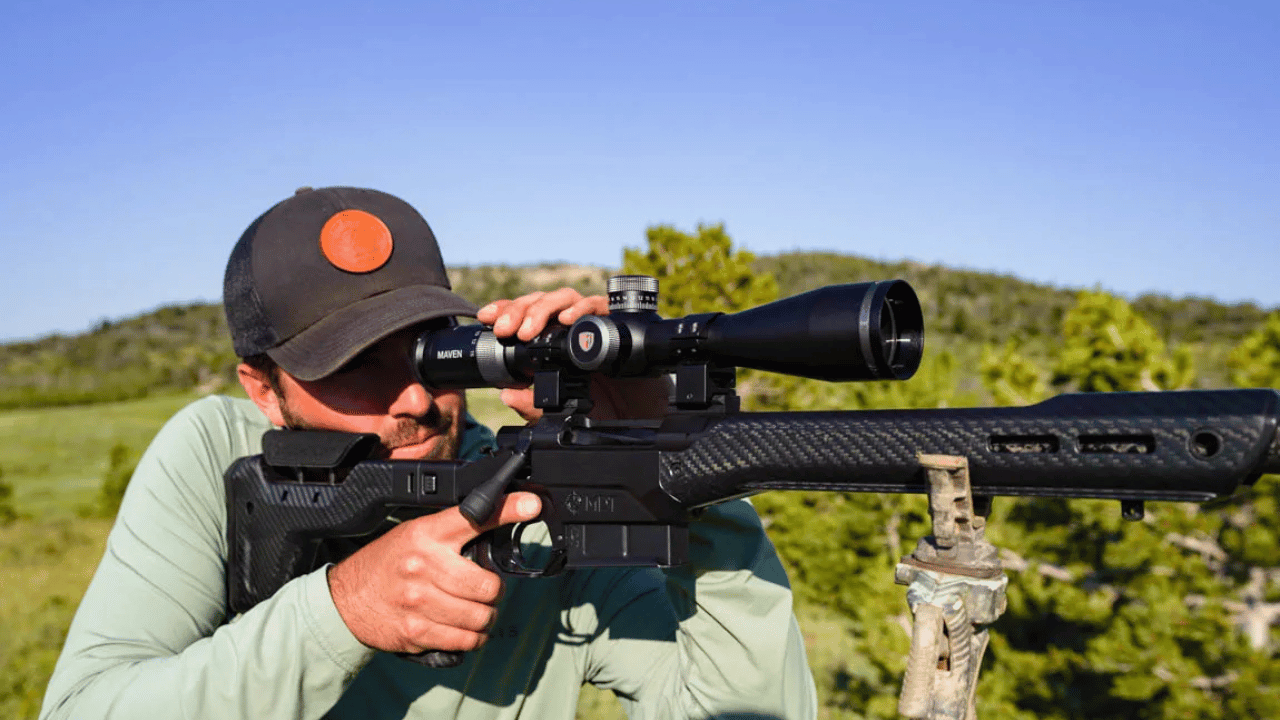
Different rifles call for different scopes. Here’s how to pair them correctly.
.22 LR Rimfire and Trainers
A .22 trainer doesn’t need a long-range scope. A simple, durable 2-7x or 3-9x with a parallax setting suited to rimfire distances (often 50 yards) is ideal. Keep it lightweight and affordable — the rifle’s job is practice and small game, and a Crossfire II is a perfect match. Pair it with cost-effective shooting practice to build fundamentals cheaply.
All-Around Bolt Action Hunting Rifles
For a .308, 6.5 Creedmoor, or .30-06 hunting rifle, a 3-9×40 or 4-12×44 is the do-everything choice. It handles bush and open country, mounts low, and keeps weight reasonable. A Diamondback or Crossfire II in this configuration covers the vast majority of Canadian big-game scenarios.
Long-Range Precision Rifles
If you’re reaching past 400 yards or shooting precision matches, step up to a 5-25×50 FFP scope with exposed tactical turrets and a holdover reticle. The Viper PST Gen II is the proven choice. The first focal plane reticle and reliable tracking let you dial and hold with confidence.
Lever Actions and Bush Guns
A .30-30 or .45-70 brush gun is built for fast, close shots. Pair it with a low-magnification scope (1-4x or 2-7x) for a wide field of view and quick target acquisition. High magnification is a liability on a rifle designed for snap shots in thick cover.
Match the Scope to Your Hunt (Canadian Terrain Guide)
Where you hunt should drive your magnification and objective choice as much as your rifle does.
Dense Bush and Hardwood (Ontario, Quebec, Maritimes)
Shots in Eastern Canadian hardwoods are typically under 150 yards in low-light cover. Prioritize a wide field of view and good light transmission over magnification. A 3-9×40 set on low power gives you fast target acquisition when a buck steps out at 40 yards, with enough top-end reach for the occasional longer shot.
Open Prairie and Farmland (Alberta, Saskatchewan)
Prairie hunting means longer shots across open ground, often 200 to 400 yards. A 4-16×44 gives you the magnification to identify and place shots at distance while still functioning at closer ranges. A holdover or BDC reticle helps with the longer trajectories common in open country.
Mountain and Backcountry (BC, Alberta Foothills)
Mountain hunting demands a balance of reach and weight. You may glass game across a valley and shoot at extended range, but you also have to carry your rifle for miles. A lightweight 4-16x or 4.5-18x with a 44mm objective offers the versatility you need without the bulk of a heavy long-range scope.
Don’t Forget Rings, Bases, and Mounting
A premium scope mounted in cheap, poorly fitted rings is a false economy that will cost you your zero. Budget for quality rings and bases matched to your scope’s tube diameter (1-inch, 30mm, or 34mm) and your rifle’s mounting system. Get the ring height right too — your objective lens must clear the barrel while keeping the scope low enough for a natural cheek weld. Victory Ridge Sports stocks a full range of scope rings, bases, and mounts to match whatever optic you choose, and our team can confirm the right combination for your rifle.
Where to Find the Best Rifle Scope in Canada
The best rifle scope is the one matched to your budget, rifle, and hunt, and the easiest way to get that match right is to talk to people who actually hunt with this gear. At Victory Ridge Sports in Barrie, Ontario, our team of active hunters and competitive shooters helps Canadian shooters choose the right optic without overspending or underbuying. We carry the full Vortex lineup across every budget tier, offer expert advice, competitive pricing, and free shipping on orders over $250 CAD Canada-wide.
For a deeper dive on specific models, see our guides on the Vortex Crossfire 2 for deer hunting and whether the Vortex Viper is worth the upgrade.
FAQ
What magnification scope do I need for deer hunting?
For most deer hunting in Canada, a 3-9×40 or 4-12×44 scope is ideal. The 3-9x suits bush and timber hunting under 200 yards, while the 4-12x adds reach for open-country shots out to 300+ yards. Avoid excessive magnification, which narrows your field of view and dims the image.
How much should I spend on a rifle scope?
A reliable entry-level scope costs $150–$350 CAD, the mid-range sweet spot runs $350–$700, and premium glass starts around $700. A good rule of thumb is to spend roughly as much on your scope as on your rifle. Prioritize glass quality over maximum magnification at every price point.
Is a bigger objective lens better?
Not always. A larger objective (50mm+) gathers more light for dawn and dusk but adds weight and requires higher rings, which can hurt your cheek weld. For most hunting, a 40mm or 44mm objective is the best balance of light gathering and practicality.
Should I choose FFP or SFP for hunting?
Choose second focal plane (SFP) for traditional hunting within 300 yards — it’s cleaner and easier to see. Choose first focal plane (FFP) if you shoot at extended ranges and rely on reticle holdovers, since FFP keeps your holdovers accurate at any magnification.
What is the best all-around rifle scope?
For most Canadian hunters, a 3-9×40 or 4-12×44 scope in the $350–$700 mid-range tier, such as the Vortex Diamondback, is the best all-around choice. It balances magnification, glass quality, weight, and price for the widest range of hunting situations.