
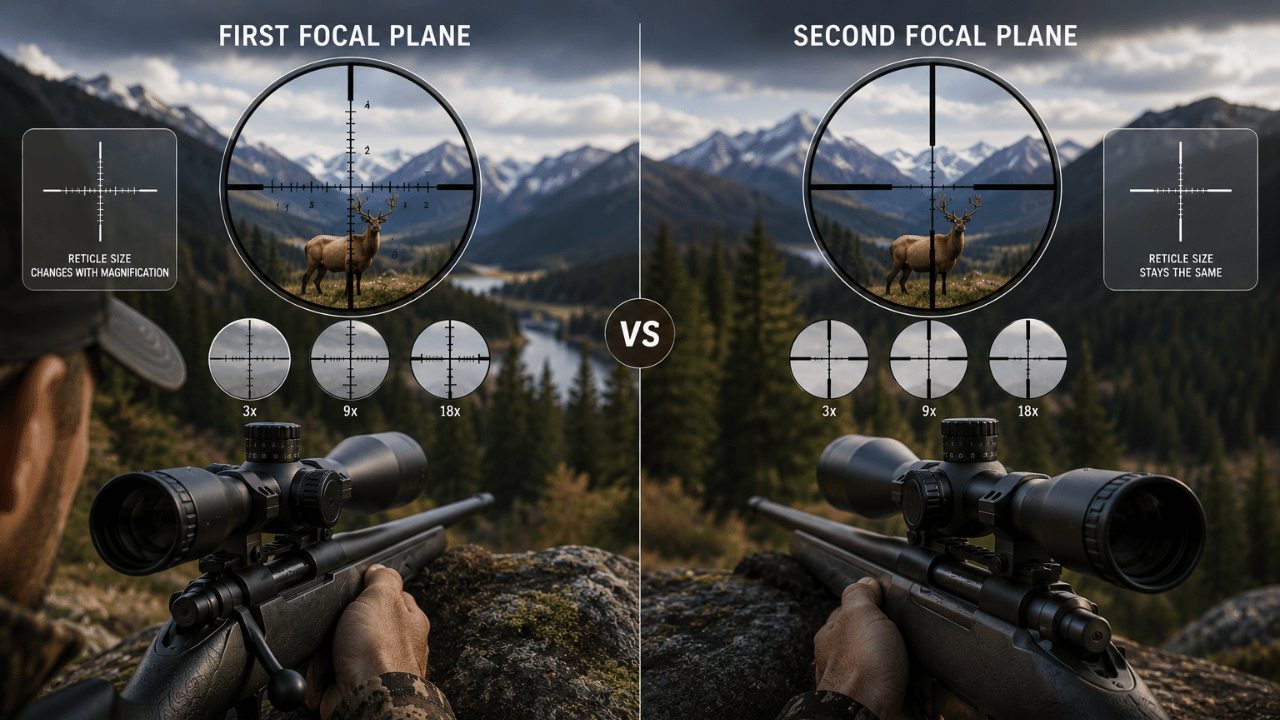
First focal plane or second focal plane — it is one of the most common questions Canadian hunters and shooters ask when buying a rifle scope, and one of the most confusing. Most online explanations are written for American competition shooters and ignore the practical reality of Canadian hunting conditions. This guide explains the difference in plain English, tells you exactly when each type matters, and gives you a clear answer based on how you actually shoot in Canada.
| For most Canadian hunters who shoot deer, moose, or elk at practical distances under 300 metres — a second focal plane (SFP) scope is the right choice. SFP scopes have a consistent, easy-to-see reticle at all magnifications, cost less at equivalent quality, and suit the way most hunters actually use a scope in the field. A first focal plane (FFP) scope is the right choice for PRS competition, NRL matches, and hunters who regularly dial or hold for shots beyond 300 metres at variable magnification. |
| Key Facts: FFP reticle scales with magnification — subtensions (MOA/MRAD values) are accurate at ALL magnification settings- SFP reticle stays the same size — subtensions are only accurate at ONE magnification (usually maximum)- FFP scopes are typically more expensive at equivalent quality due to manufacturing precision required- PRS competition: FFP is near-universal — stages often require holdovers at unknown magnification settings- Most successful shots on Canadian big game occur under 300 metres — at these distances, SFP scopes are fully adequate- As MDT’s Rob Orgel (Marine Sniper instructor, 300+ range days/year) notes: FFP ‘shines during PRS and NRL competition’ |
What Is the Actual Difference Between FFP and SFP?
Every variable-power rifle scope has a reticle — the crosshair or aiming pattern you look through. The focal plane question is simply: where inside the scope is that reticle positioned relative to the magnification lens system?
First Focal Plane (FFP) — Reticle Scales With Magnification
In an FFP scope, the reticle is positioned in front of the magnification lenses. As you increase magnification, both the target image AND the reticle grow together at the same rate. This means the relationship between the reticle’s hash marks and the target’s size stays constant — a hash mark that represents 1 MRAD at 6x still represents exactly 1 MRAD at 24x.
The practical result: you can use your reticle’s holdover marks, ranging capabilities, and wind dots accurately at any magnification setting — without doing any conversion math. Whatever power your scope is set to when the moment of truth arrives, your holdovers are correct.
Second Focal Plane (SFP) — Reticle Stays the Same Size
In an SFP scope, the reticle is positioned behind the magnification lenses. As you increase magnification, the target image grows but the reticle stays the same size. This means the reticle’s hash marks represent different values at different magnification settings — a mark worth 1 MRAD at 24x is worth 0.25 MRAD at 6x.
The practical result: if you want to use holdovers accurately, you must be at the specific magnification where the manufacturer calibrated them — almost always maximum power. At any other magnification, you must either do the math or simply aim at the centre of the reticle and rely on turret adjustments.
FFP vs SFP — Complete Head-to-Head Comparison
| Feature | First Focal Plane (FFP) | Second Focal Plane (SFP) |
| Reticle size | Grows with magnification | Stays the same size always |
| Subtensions accurate at | ALL magnification settings | ONE setting (usually maximum) |
| Holdover accuracy | Correct at any power — no math needed | Only correct at calibrated magnification |
| Reticle visibility at low power | Can be thin and hard to see | Bold and easy to see — consistent |
| Reticle at high power | Large — may obscure small targets | Same size as low power — clean |
| PRS / NRL competition | Preferred — near universal choice | Disadvantage on timed stages |
| Hunting under 300m | Works well but advantage rarely needed | Fully adequate — simpler to use |
| Hunting over 300m | Advantage when holding at variable power | Must be at max power for holdovers |
| Price at equivalent quality | More expensive | Less expensive |
| Best for | PRS, NRL, long-range variable-distance | Hunting, benchrest, fixed-distance |
For Canadian Hunters — Which Focal Plane Is Actually Better?
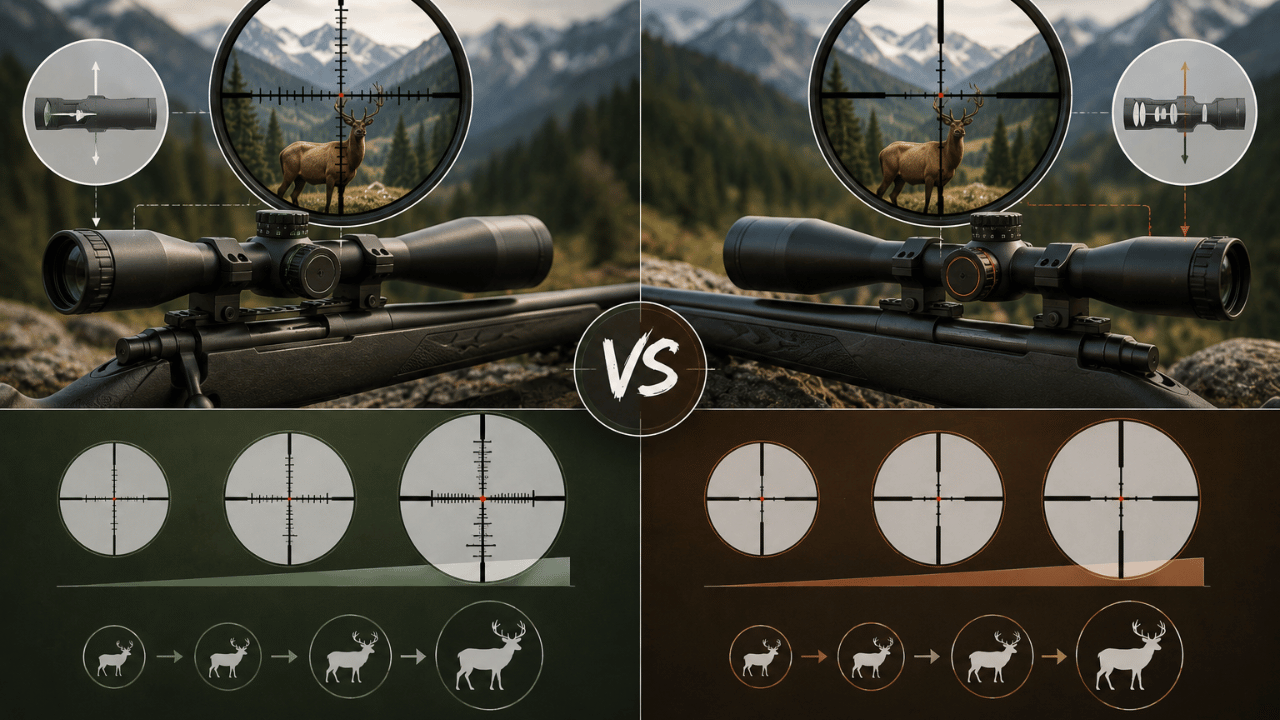
This is where most online articles get it wrong. They explain the technical difference perfectly and then conclude ‘FFP is better’ — without acknowledging that the advantage of FFP only matters in specific shooting situations that most Canadian hunters rarely encounter.
When SFP Is the Right Choice for Canadian Hunters
The majority of successful shots on Canadian big game — whitetail, mule deer, moose, black bear — occur at under 300 metres. At these distances, most hunters dial to maximum magnification before shooting and aim at the centre of the reticle or dial their turrets. In this scenario — maximum magnification, centre-of-reticle aim, turret-dialled solution — SFP and FFP perform identically. The SFP scope’s consistent, bold reticle that remains easy to see at low power for target acquisition is actually an advantage in Ontario’s November timber where fast target acquisition matters more than precise holdovers.
- Ontario and Quebec bush hunting — shots typically 50-150m, fast acquisition more important than holdover precision
- Stand hunting — you have time to dial to max power before the animal presents a shot opportunity
- Any hunting under 300m where you consistently use maximum magnification — SFP holdovers are perfectly accurate
- Budget-conscious hunters — equivalent SFP quality costs significantly less than equivalent FFP quality
When FFP Is the Right Choice for Canadian Hunters
FFP earns its price premium in two Canadian hunting scenarios: open-country hunting where shots occur at variable distances and magnification settings, and any situation where time pressure prevents dialling to maximum before shooting. BC mountain hunters pursuing mule deer at 300-500 metres across alpine terrain regularly change magnification as animals move and shooting opportunities shift. For these hunters, FFP’s ability to hold accurately at any magnification eliminates a potential error source at the moment of truth.
- BC and Alberta mountain hunting — variable distances, changing magnification as animals move
- Prairie long-range hunting — shots at 300-500m where dialling is practical but holdover backup is valuable
- Hunters who also compete in PRS — one FFP scope serves both applications
- Any situation where you may need to take a shot at non-maximum magnification
For PRS and Precision Competition — FFP Is the Clear Choice
In PRS and NRL competition, FFP is near-universal at the serious level. The reason is specific to how competition stages work: some PRS match directors specifically design stages where competitors cannot dial their turrets, forcing holdovers at unknown magnification settings. In this scenario, an SFP scope’s holdovers become useless at anything other than maximum magnification. An FFP scope’s holdovers work correctly regardless of what power the scope was last set to.
For Canadian PRS shooting — where stages demand fast target acquisition at varying distances, quick power changes, and the ability to hold corrections on the fly — FFP removes the guesswork. PRS competitors who use SFP scopes carry a significant disadvantage on stages designed to exploit that limitation.
FFP vs SFP in the Vortex Canada Lineup — Real Examples
| Model | Focal Plane | Magnification | Price (CAD) | Best For |
| Vortex Crossfire II 3-9×40 | SFP | 3-9x | ~$250 | Budget hunting under 250m |
| Vortex Diamondback Tactical 4-16×44 | FFP | 4-16x | ~$450 | Mid-range hunting + light PRS |
| Vortex Viper PST Gen II 5-25×50 | FFP | 5-25x | ~$950 | Long-range hunting + PRS |
| Vortex Viper HS-T 6-24×50 | SFP | 6-24x | ~$850 | Benchrest, fixed-distance varmint |
| Vortex Razor HD Gen III 6-36×56 | FFP | 6-36x | ~$2,400 | Top-tier PRS competition |
| Vortex Strike Eagle 5-25×56 | FFP | 5-25x | ~$500 | Budget PRS / long-range value |
Browse the full range of rifle scopes at Victory Ridge Sports to compare current Canadian availability across the Vortex and other optic brands. See our complete rifle scope buying guide for the full Canadian hunter’s framework beyond just focal plane selection.
FFP vs SFP by Canadian Hunting Scenario
- Ontario whitetail — bush, 50-150m, quick shots -> SFP with 3-9x or 2-7x. Bold reticle for fast acquisition in low-light November timber.
- Alberta mule deer — open prairie, 200-400m, time to dial -> FFP or SFP both work. FFP preferred if you hunt at variable magnification.
- BC mountain hunting — alpine, variable distance, changing conditions -> FFP. The ability to hold correctly at any power pays off when animals are moving.
- Moose hunting Ontario — close to medium range, dense cover -> SFP. Fast target acquisition and a large, clear reticle in low light is the priority.
- PRS competition Canada — stages with holdover requirements at unknown magnification -> FFP mandatory at competitive level.
- Varmint / coyote — fixed or close-to-maximum magnification -> SFP adequate. Clean, consistent reticle at max power is all you need.
The Simple Decision Framework — FFP or SFP?
| Choose SFP if: You hunt big game at under 300 metres primarily- You consistently shoot at maximum magnification before firing- You are on a budget — equivalent SFP quality costs less than FFP- You hunt in dense cover where a bold, consistent reticle aids fast acquisition- You are buying your first quality hunting scope |
| Choose FFP if:- You compete in PRS, NRL, or CRPS matches- You hunt open country at 300-500+ metres with variable magnification- You want one scope that serves both hunting and competition- You use holdovers rather than dialling for quick shooting opportunities- You are a BC or Alberta mountain hunter with multi-hour glassing sessions |
Frequently Asked Questions
Q: What does first focal plane mean on a rifle scope?
A: First focal plane (FFP) means the reticle is positioned in front of the magnification lenses inside the scope. As you increase magnification, both the target image and the reticle grow at the same rate — keeping the reticle’s hash marks proportionally consistent with the target at all power settings. This means holdover marks, wind dots, and ranging subtensions are accurate at every magnification, not just maximum.
Q: Why are first focal plane scopes more expensive?
A: FFP scopes require the reticle to be manufactured with much more precise subtension values, since any manufacturing error is magnified along with the reticle as power increases. The reticle must also be positioned with higher precision within the optical system. These manufacturing requirements increase production cost at every quality tier, which is why an FFP scope typically costs more than an equivalent SFP scope from the same manufacturer.
Q: Can I use a second focal plane scope for long-range deer hunting in Canada?
A: Yes — most Canadian deer hunters use SFP scopes effectively at long range by shooting at maximum magnification, where the SFP scope’s holdovers are calibrated and accurate. If you consistently dial to maximum power before shooting and use turret adjustments or holdovers only at that setting, an SFP scope performs identically to an FFP scope. The SFP limitation only becomes a practical problem when you need accurate holdovers at a magnification other than the calibrated setting.
Q: What focal plane do most Vortex hunting scopes use?
A: Vortex offers both focal planes across their lineup. Budget hunting scopes like the Crossfire II are typically SFP. Mid-tier tactical and precision scopes like the Diamondback Tactical and Viper PST Gen II are FFP. The Viper HS-T — designed for benchrest and fixed-distance varmint use — is SFP. The Razor HD Gen III for competition is FFP. The focal plane choice in the Vortex lineup broadly follows the application: hunting-focused models tend toward SFP, precision and competition models toward FFP.
Q: Do PRS competitors in Canada use FFP or SFP scopes?
A: At the competitive level in Canadian PRS and NRL matches, first focal plane scopes are near-universal. The reason is specific to PRS stage design — some stages specifically prevent competitors from dialling their turrets, requiring holdovers at whatever magnification the scope is currently set to. An SFP scope’s holdovers are only accurate at one magnification, creating a significant disadvantage on these stages. Experienced PRS competitors in Canada almost exclusively run FFP scopes.
Where to Find FFP and SFP Scopes in Canada
Victory Ridge Sports stocks a range of FFP and SFP rifle scopes for Canadian hunters and competitors — from budget SFP hunting scopes to competition-grade FFP optics. Pair your scope with the right bolt action rifle for your intended application. See our best bolt action rifles Canada 2026 guide and the complete rifle scope buying guide to build a matched system.