
Buying your first bolt action rifle is an exciting step, but it can also feel overwhelming. Walk into any gun store or browse online and you’re hit with dozens of brands, a confusing wall of calibers, and plenty of contradictory advice from forums and well-meaning friends. The good news is that choosing a great first rifle isn’t complicated once you understand what actually matters.
In this blog post we will walk you through everything a first-time buyer in Canada needs to know: why a bolt action is the smart first choice, what features to look for, which caliber to pick, how the PAL process works, a realistic budget, and a few honest rifle recommendations. By the end, you’ll be ready to buy with confidence instead of guesswork.
The Short Answer for Beginners
Your first bolt action rifle should be a reliable, accurate model with a good adjustable trigger and a durable synthetic stock, chambered in a versatile, manageable caliber, and matched to your budget and intended use. For most new Canadian shooters, that means a proven rifle like a Ruger American or Savage Axis in .308 or 6.5 Creedmoor, paired with a modest scope, for a total setup under $1,000.
Don’t overspend, don’t over-magnify your scope, and don’t buy more recoil than you can comfortably shoot. A humble, accurate rifle you enjoy shooting will make you a better marksman than an expensive one that punishes your shoulder. Everything below explains how to make that choice for your specific situation.
Why a Bolt Action Is the Ideal First Rifle
Before we get into how to choose, it’s worth understanding why a bolt action is the right first rifle for the vast majority of new shooters and hunters. It isn’t just tradition or nostalgia driving that recommendation. The bolt action platform has stayed at the top of the hunting and target world for nearly two centuries because it does the fundamentals better than anything else, and those same qualities make it uniquely well suited to someone just starting out. When you’re learning, you want a rifle that is forgiving, dependable, and lets you see the direct results of your own technique. A bolt action delivers exactly that, and here’s why it stands above the alternatives for a first purchase.
Simple, Reliable, and Easy to Maintain
A bolt action has fewer moving parts than a semi-automatic, which makes it inherently more reliable, easier to clean, and simpler to learn on. There’s no gas system to foul, no complex cycling to troubleshoot. You manually work the bolt to load, fire, and eject, which also keeps you deliberate and safety-focused as you build your fundamentals. For a beginner still learning safe handling, that simplicity is a real advantage.
Exceptional Accuracy Builds Good Habits
Because the bolt locks solidly into the receiver, a bolt action delivers consistent headspace and excellent accuracy shot after shot. Starting on an accurate rifle matters more than beginners realize. When your rifle does its job, you can see the direct results of your technique, which accelerates your learning and builds confidence. An inaccurate, fussy first rifle does the opposite.
Affordable to Buy and Shoot
Modern manufacturing has made accurate, durable bolt action rifles more affordable than ever. You no longer need to spend a month’s salary to get a rifle that shoots well. A quality entry-level bolt action costs a fraction of a premium rifle while delivering 95% of the real-world performance a new shooter needs.
What to Look For in Your First Bolt Action Rifle
Once you’ve decided on a bolt action, the next challenge is sorting through the features that genuinely affect your shooting from the ones that are just marketing. Manufacturers love to advertise flashy specifications that sound impressive but make little practical difference to a new shooter. What actually matters is more fundamental: how the rifle cycles, how the trigger breaks, how the stock holds up, and how well the whole package fits your body. Get these core elements right and you’ll have a rifle that helps you improve rather than one that holds you back.
Here are the features that actually matter, and what to look for in each:
A Smooth, Reliable Action
The action is the heart of the rifle, and a smooth one makes shooting more enjoyable and helps prevent short-stroking (failing to fully cycle the bolt). You don’t need a custom-smooth action on your first rifle, but the bolt should cycle without excessive grit or binding. Most modern rifles from reputable brands meet this standard.
A Good, Adjustable Trigger
The trigger has more influence on your accuracy than almost any other feature. Look for a rifle with a clean, light, adjustable trigger. Savage’s AccuTrigger and Ruger’s Marksman Adjustable trigger are two excellent factory triggers found on affordable rifles, both user-adjustable to a comfortable pull weight without a gunsmith. A good trigger helps you break the shot without disturbing your aim.
A Durable Composite Stock
For a first rifle, a synthetic composite stock is almost always the right choice over wood. It’s more durable, weather-resistant, and won’t leave you feeling awful the first time you scratch it in the field. Wood stocks look beautiful but cost more, require more care, and can shift point of impact in wet conditions. Save the wood-stocked rifle for later in your journey.
The Right Weight and Fit for You
A rifle that fits you is a rifle you’ll shoot well. The length of pull (distance from trigger to buttstock) should let you shoulder the rifle comfortably, and the weight should feel manageable both when carrying and when holding steady on target. Smaller-framed shooters and those who wear heavy winter clothing should consider a compact model with a shorter length of pull.
Magazine Type: Detachable vs Internal
Rifles feed from either a detachable box magazine, an internal magazine with a hinged floorplate, or a blind magazine. Detachable magazines are convenient and let you carry spares, which is why they’re popular with new shooters coming from the semi-auto world. Internal magazines are simpler and have nothing to lose. Either works fine for a first rifle, so choose based on preference.
Should You Start With a .22 LR or Jump Straight to a Hunting Caliber?
This is one of the most valuable questions a new shooter can ask, and one most buyers never stop to consider before spending their money. There’s a natural temptation to buy the biggest, most capable rifle you can afford right away, especially if hunting season is your goal. But the smartest path for building real, lasting skill often looks different than what most beginners expect. The caliber you learn on shapes how quickly you develop good habits, how much you’ll actually practice, and how much you’ll spend along the way. Understanding the trade-offs here can save you money and make you a measurably better shot in the long run.
The Case for Learning on a .22 First
There’s a strong argument that your first bolt action should be a .22 LR rimfire. A .22 has almost no recoil, so you can focus purely on fundamentals like trigger control, breathing, and sight picture without flinching. The ammunition is extremely cheap, so you can shoot hundreds of rounds for the price of a single box of centrefire. And a .22 bolt action often mirrors the ergonomics of a full-size hunting rifle, so the skills transfer directly. Many experienced shooters wish they’d started here. Rifles like the Savage Mark II are affordable, accurate, and perfect for building a foundation.
When to Go Straight to a Centrefire Hunting Rifle
If your primary goal is hunting big game this season and you have limited time, going straight to a centrefire hunting rifle in a manageable caliber makes sense. You’ll need to put in extra practice to master the recoil, but a low-recoil centrefire like a .243 or 6.5 Creedmoor is beginner-friendly enough to learn on directly.
The Best of Both Worlds: Own Both
The ideal path for many new shooters is to own both a .22 trainer and a centrefire hunting rifle. You practice cheaply and frequently on the .22 to build skills, then apply those skills to your hunting rifle. The .22’s low ammo cost means it pays for itself quickly through practice savings. Pair either rifle with structured shooting practice to get the most out of your range time.
Choosing the Right Caliber for a Beginner
Caliber choice comes down to two things: what you plan to hunt or shoot, and how much recoil you can comfortably handle as a new shooter. Beginners often make the mistake of choosing a caliber based on what sounds powerful or what a friend swears by, rather than what actually fits their needs and their tolerance for recoil. The truth is that the right caliber is the one that lets you practice comfortably, shoot accurately, and ethically take whatever game you’re after. There’s no single best answer, but there are clear, sensible choices depending on your goals.
Here’s how to think it through:
Best Low-Recoil Calibers for New Shooters
Recoil is the enemy of good technique for beginners. Heavy recoil causes flinching, which wrecks accuracy. Start with a manageable caliber. The .223 Remington, .243 Winchester, and 6.5 Creedmoor all offer mild recoil that lets you focus on fundamentals while still being effective on game.
The Most Versatile All-Around Choices
For a first centrefire hunting rifle, the .308 Winchester and 6.5 Creedmoor are the two most versatile choices. Both are accurate, widely available in Canada, effective on deer and larger game, and manageable in recoil. If you want one rifle that does almost everything, either of these is an excellent starting point.
Matching Caliber to Canadian Game
| Caliber | Recoil | Best For |
| .22 LR | Minimal | Training, small game (rabbit, grouse) |
| .223 Rem | Light | Varmints, predators (coyote, fox) |
| .243 Win | Light-Mild | Deer, youth and new hunters |
| 6.5 Creedmoor | Mild | Deer, longer-range, versatile all-rounder |
| .308 Win | Moderate | Deer, black bear, moose — the classic all-rounder |
Note that .22 LR and .223 are not legal for big game like deer in most Canadian provinces. Always check your provincial regulations before buying.
Buying Your First Rifle in Canada: The PAL and Budget
This is the part most rifle-buying guides skip entirely, because the majority of them are written for an American audience. But for Canadian shooters, understanding the legal process and setting a realistic budget is just as important as choosing the rifle itself. Buying a firearm in Canada involves a licensing step that you need to plan for well in advance, and the total cost of getting started is more than just the price tag on the rifle. Knowing what to expect on both fronts means you can plan properly, avoid surprises, and get out to the range without unnecessary delays or overspending. Here’s exactly what you need to purchase your first rifle in Canada.
You Need a PAL: Here’s What That Means
To buy any firearm in Canada, including your first bolt action rifle, you need a valid Possession and Acquisition Licence (PAL). To get one, you complete the Canadian Firearms Safety Course (CFSC), pass the written and practical exams, and submit your application to the RCMP Canadian Firearms Program. For non-restricted rifles (which includes virtually all the beginner rifles in this guide), you need the standard non-restricted PAL. The process typically takes a couple of months, so start early.
A Realistic First-Rifle Budget
You don’t need to spend a fortune.
Here’s a realistic budget for a complete first setup in Canadian dollars:
| Item | Budget Range (CAD) |
| Rifle | $500 – $800 |
| Scope | $150 – $350 |
| Rings & bases | $30 – $80 |
| Ammunition (starter) | $40 – $80 |
| Cleaning kit & basics | $40 – $60 |
| Total | ~$760 – $1,370 |
A great rule of thumb for beginners is to keep your first rifle-and-scope combo around or under $1,000. You’ll likely upgrade later as your skills and preferences develop, so there’s no need to buy premium gear on day one.
Buy the Rifle-and-Scope Combo When You Can
Many entry-level rifles are sold as a package with a scope already mounted and bore-sighted. For a beginner, this is often the smartest buy. It saves money, ensures compatibility, and gets you shooting sooner. Even if you upgrade the scope later, a combo gets you started at the lowest possible cost.
Recommended First Bolt Action Rifles for Canadian Beginners
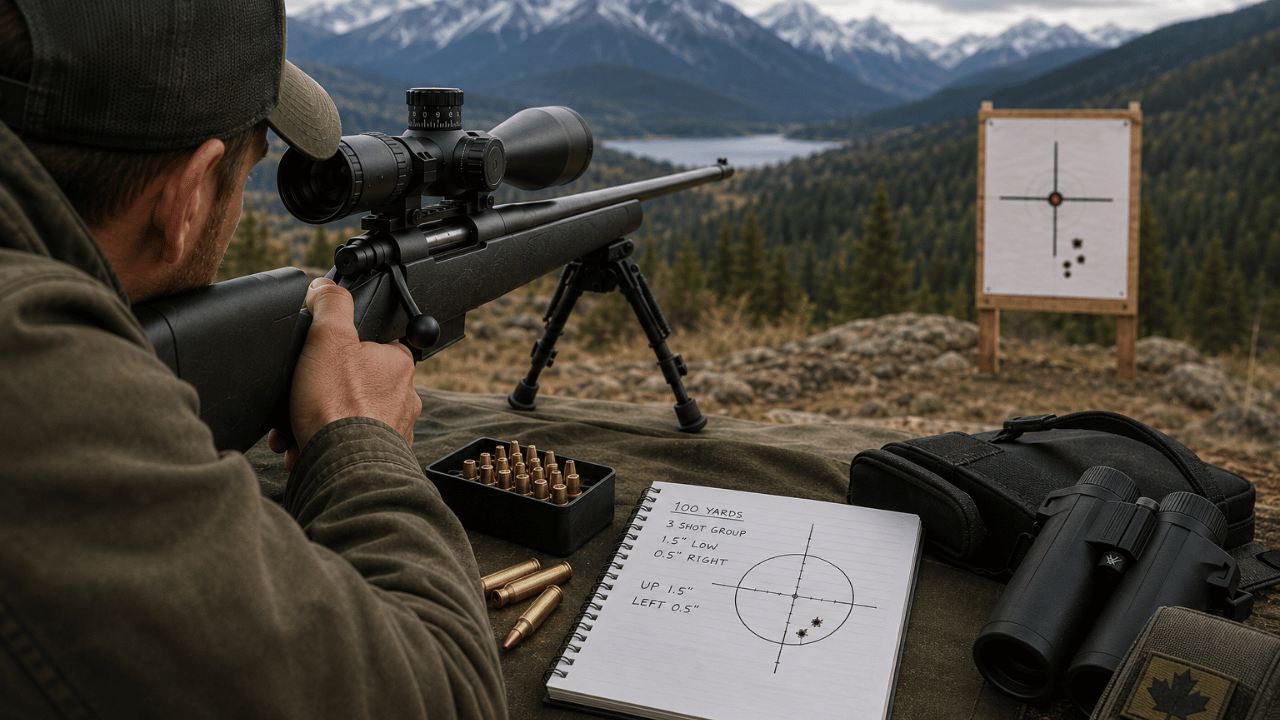
With the fundamentals covered, it helps to have a few concrete starting points rather than staring at an endless catalog of options. The rifles below are the ones we recommend most often to first-time buyers at Victory Ridge Sports, and they’ve earned that recommendation through real-world reliability, out-of-the-box accuracy, and genuine value for the money. None of them will break your budget, all of them will serve you well for years, and each one is a proven choice that thousands of Canadian shooters have started their journey on.
Here are our top picks for a first bolt action rifle:
Best Overall Value: Ruger American
The Ruger American is the rifle we recommend most to new hunters. It features a cold hammer-forged barrel (a premium feature at its price), the user-adjustable Marksman trigger, Power Bedding for outstanding accuracy, and a lightweight synthetic stock. The Compact model with its shorter length of pull is ideal for smaller-framed shooters, youth, or anyone hunting in heavy winter clothing. It’s affordable, accurate, and hard to beat as a first rifle.
Best Adjustable Beginner Rifle: Savage 110 / Axis
Savage’s rifles are renowned for out-of-the-box accuracy thanks to the AccuTrigger, and many models feature the AccuFit system that lets you adjust length of pull and comb height to fit you perfectly. That adjustability is a genuine advantage for a new shooter still finding their ideal fit. Browse the full selection of bolt action rifles to compare options.
Best .22 Trainer to Start On: Ruger American Rimfire
If you want to build fundamentals cheaply before stepping up to a centrefire, the Ruger American Rimfire is an ideal starting point. At 5.1 pounds with a threaded barrel, factory scope rail, and the same Marksman Adjustable trigger as its centrefire big brother, it lets you practice for pennies per round while building skills that transfer directly to your hunting rifle.
Common Beginner Mistakes to Avoid
A few simple mistakes trip up almost every first-time buyer.
Avoid these and you’ll be ahead of the game:
- Overspending on your first rifle. You’ll likely upgrade as your preferences develop. Start affordable and put saved money toward ammunition and practice.
- Buying too much magnification. A 3-9x scope covers almost all beginner needs. High magnification narrows your field of view and amplifies wobble.
- Choosing too much recoil. Don’t start with a hard-kicking magnum. Heavy recoil builds a flinch that takes months to unlearn.
- Skipping practice. The rifle is only half the equation. Regular, structured practice is what actually makes you a good shot.
- Forgetting the extras. Budget for rings, bases, ammo, ear and eye protection, and a cleaning kit, not just the rifle.
Final Thoughts
At Victory Ridge Sports, we love helping first-time buyers get started right. Based in Barrie, Ontario, our team of active hunters and shooters will walk you through choosing your first rifle, scope, and everything else you need, with no pressure and no upselling. We offer expert advice, competitive pricing, and free shipping on orders over $250 CAD Canada-wide. Browse our full bolt action rifle collection → or visit us in-store to handle a few and find the one that fits you best.
FAQ
What is the best bolt action rifle for a beginner in Canada?
The Ruger American and Savage Axis are two of the best beginner bolt action rifles in Canada. Both offer excellent accuracy, adjustable triggers, durable synthetic stocks, and affordable pricing, typically under $800. For a first rifle, either paired with a modest scope makes an ideal starter setup.
Do I need a PAL to buy my first rifle in Canada?
Yes. You need a valid Possession and Acquisition Licence (PAL) to buy any firearm in Canada. For non-restricted bolt action rifles, you need the standard non-restricted PAL, which requires completing the Canadian Firearms Safety Course (CFSC) and passing its exams.
Should my first rifle be a .22 or a hunting caliber?
Starting with a .22 LR is a smart choice for many beginners because it has minimal recoil and cheap ammunition, letting you build fundamentals affordably. If your primary goal is hunting this season, a low-recoil centrefire like a .243 or 6.5 Creedmoor is beginner-friendly enough to start on directly.
How much should I spend on my first bolt action rifle?
A good rule of thumb is to keep your first rifle-and-scope combo around or under $1,000 CAD. A quality entry-level rifle runs $500 to $800, with a modest scope adding $150 to $350. You’ll likely upgrade later, so there’s no need to buy premium gear initially.
What caliber is best for a beginner deer hunter?
For a beginner deer hunter in Canada, the 6.5 Creedmoor and .308 Winchester are the top choices. Both offer manageable recoil, excellent accuracy, wide ammunition availability, and proven effectiveness on deer and larger game, making them versatile all-around first calibers.