
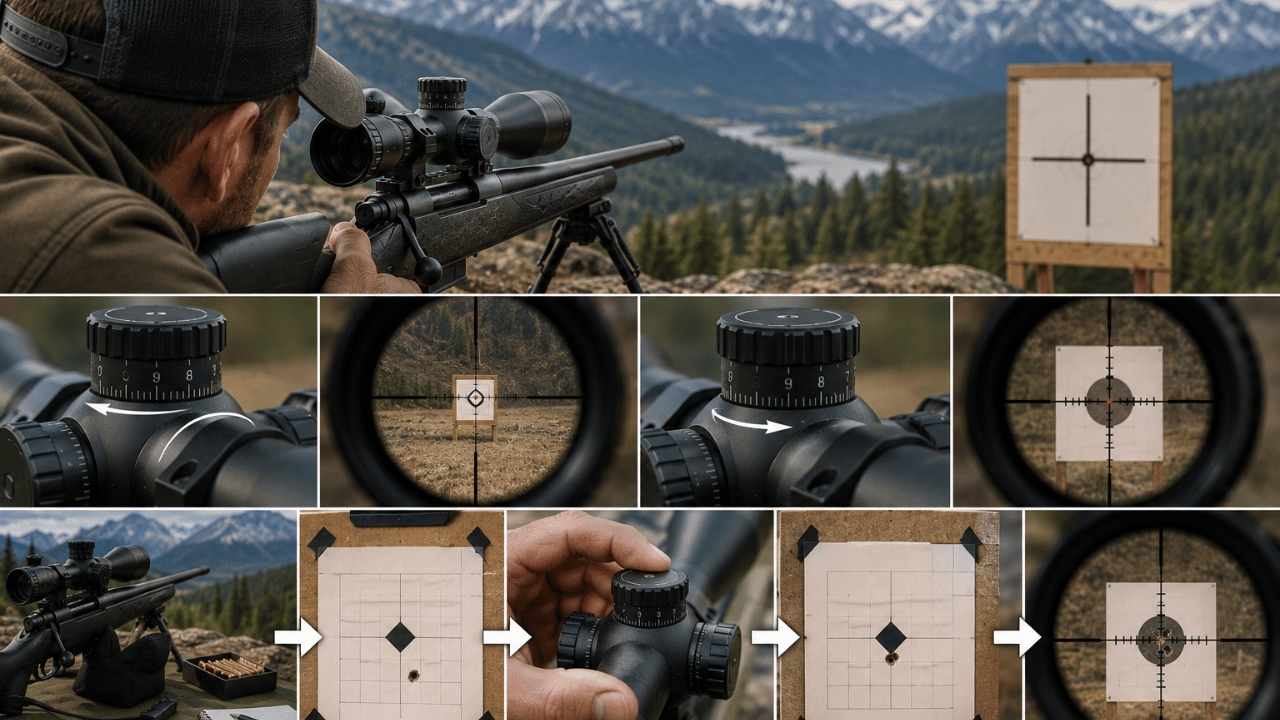
Zeroing a rifle scope is the single most important step between buying a new rifle and taking it into the field. A rifle that is not properly zeroed will miss – regardless of how accurate the platform is mechanically or how skilled the shooter. This guide covers the complete zeroing process for Canadian hunters and shooters, including the 25-metre/100-metre two-step method used at most Canadian outdoor ranges, MOA and MRAD click calculations, and the common mistakes that waste ammunition and lead to a false zero.
| Zero your rifle scope at 25 metres first to get on paper efficiently, then move to 100 metres for your confirmed hunting zero. Use shooting bags on a solid bench for all zeroing – human tremor produces unreliable groups from a free-hold position. Standard MOA scopes move 1/4 inch per click at 100 yards (approximately 0.7cm per click at 100 metres). Fire 3-shot groups and adjust based on group centre – never adjust after a single shot. |
| Key Facts: – Standard 1/4 MOA scope: each click moves point of impact ~0.25 inch (6.5mm) at 100 yards / ~0.7cm at 100 metres – Standard 0.1 MRAD scope: each click moves point of impact ~0.36 inch (9.3mm) at 100 yards / ~1cm at 100 metres – 100 metres is the standard Canadian hunting zero – used by RCMP ballistic tables and most Canadian ammunition ballistic charts – A bullet 2 inches low at 25 metres will be approximately 8 inches low at 100 metres with 1/4 MOA turrets – Most Canadian outdoor ranges are 100 or 200 metres – confirm your range’s distances before zeroing – Bore sighting typically places first shots within 3-6 inches at 100 yards – enough to get on paper |
What Does Zeroing a Rifle Scope Actually Mean?
Zeroing (also called sighting-in) means adjusting your scope’s reticle so that your point of aim and point of impact coincide at a specific distance. A rifle’s bore points slightly downward relative to the scope’s line of sight – because the scope sits above the barrel, the two lines converge at the zero distance and diverge before and after it. Setting your zero at 100 metres means your bullet and your crosshair are at the same point at 100 metres; at shorter and longer distances, you must compensate for the difference.
It is important to understand that zeroing is not a one-time event. You should re-zero your rifle after mounting a new scope, after the rifle experiences a significant impact, when you change ammunition, at the start of each hunting season, and after any significant temperature change – since most calibres produce different muzzle velocities in extreme cold compared to summer conditions.
Equipment You Need Before You Start
Zeroing accurately requires a stable platform. The most common zeroing mistake is attempting to zero from an unstable or improvised rest. Your groups will be larger than the rifle’s actual mechanical accuracy, leading to scope adjustments that chase human error rather than genuine mechanical offset.
- Shooting bags – front and rear bags create a stable, repeatable rest that removes human tremor from the zeroing equation. See our full guide on choosing quality shooting bags for range work.
- Stable shooting bench or bipod on level ground – do not zero from a standing position or improvised rest
- Zeroing targets – use a target with clear aiming point and gridlines for measuring group offset
- Ammunition – use the same ammunition you plan to hunt with; different loads zero differently in the same rifle
- Torque wrench – confirm scope ring screws are tightened to manufacturer specification before firing
- Pen and data book – record your zero setting, ammunition, and conditions for future reference
At Victory Ridge Sports we stock shooting bags suitable for zeroing sessions from bench rest to field positions, alongside bolt action rifles and quality rifle scopes for Canadian hunters.
Which Zero Distance Should Canadian Hunters Use?
| Zero Distance | Best For | Typical Calibres | Point Blank Range |
| 25 metres | Starting point only – get on paper | All calibres | Use as step 1, always confirm at 100m |
| 100 metres | Ontario/Quebec deer and moose hunting | .308 Win, .30-06, 6.5 CM, .300 WM | Accurate to ~250m with modest holdover |
| 200 metres | Alberta/BC open country hunting | 6.5 Creedmoor, .300 Win Mag | Point-blank to ~275m; minimal holdover |
| 50 yards | Indoor Canadian ranges (yards) | .22 LR rimfire | Rimfire specific – standard indoor zero |
| Canadian Standard: Most Canadian hunters zero at 100 metres. Ontario’s MNRF and most provincial wildlife management ballistic resources reference a 100-metre zero for standard hunting calibres. Use metres, not yards – Canadian ranges are almost always measured in metres. |
Step-by-Step: How to Zero a Rifle Scope in Canada
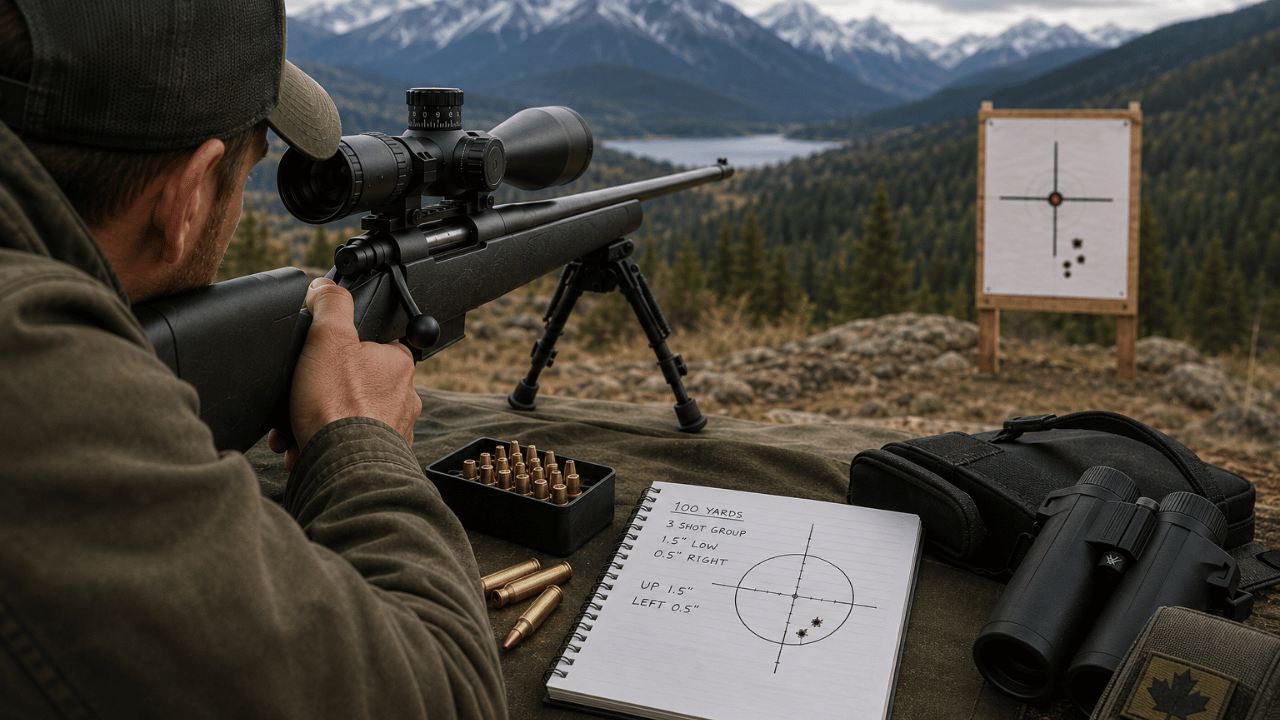
Step 1 – Mount Your Scope Correctly
Before firing a single shot, confirm your scope is properly mounted. Loose scope rings cause zero drift after every few shots and make the zeroing process impossible. Use a torque wrench to tighten ring cap screws to the manufacturer’s specified value – typically 15-25 inch-pounds for most quality aluminium rings. Check that the reticle is level (uncanted) relative to the rifle’s receiver – a canted reticle causes windage error that increases with distance.
Step 2 – Bore Sight for Initial Alignment
Bore sighting places your scope’s reticle in rough alignment with the bore before firing. For a bolt action rifle: remove the bolt, rest the rifle on bags, look through the bore and centre a target at 25 metres in the bore. Without moving the rifle, adjust the scope’s turrets until the reticle also centres on the same target. This typically places your first shots within 3-6 inches at 100 metres – on paper from the first shot.
A laser bore sighter does the same thing faster and without removing the bolt. Insert it into the muzzle or chamber, align the scope reticle to the projected laser dot. Either method saves 5-10 rounds of ammunition finding your first impact.
Step 3 – Set Up at 25 Metres First
Place your target at 25 metres. Use your shooting bags for a stable bench rest – the rifle should sit naturally on the bags with the crosshair on target without muscle assistance. Fire a 3-shot group. Measure the group centre’s distance and direction from your aim point.
| 25-Metre Rule: If your group centre is 2cm to the right and 1cm high at 25 metres, it will be approximately 8cm right and 4cm high at 100 metres. Correct most of the error at 25 metres, then fine-tune at 100 metres. This saves significant ammunition. |
Step 4 – Calculate and Make Your Adjustments
This is where most new shooters make mistakes. Understanding click values is essential:
| Turret Type | Per Click at 100m | Per Click at 25m | Example |
| 1/4 MOA (standard hunting) | ~0.73cm (~0.29in) | ~0.18cm | 4cm left = ~22 clicks right at 100m |
| 1/8 MOA (precision) | ~0.36cm (~0.14in) | ~0.09cm | 4cm left = ~44 clicks right at 100m |
| 0.1 MRAD (metric) | 1.0cm exactly | 0.25cm | 4cm left = 4 clicks right at 100m |
| 0.25 MRAD | 2.5cm | 0.625cm | 4cm left = ~2 clicks right at 100m |
Remember the direction rule: move the reticle toward your impact point. If your shots are low and left, dial UP and RIGHT. The scope turret markings (U = Up, R = Right) indicate the direction the point of impact moves – dial in the direction you want the bullet to go.
Step 5 – Move to 100 Metres and Confirm
Once your 25-metre groups are centred (or close), move to 100 metres. Fire a 3-shot group from a stable bags rest. Measure the group centre’s offset from your aim point. Make fine adjustments using your click values. Fire a confirmation group of 3 shots. If the group centre is on your aim point, your scope is zeroed.
| Important: Never adjust your scope based on a single shot. Always fire a minimum 3-shot group and adjust based on the group’s centre – not your worst shot. One outlier from a bad trigger pull can send you chasing a false zero for 20+ rounds. |
Step 6 – Fire Two More Groups to Confirm
A single centred group does not confirm a zero – it confirms one good group. Fire two more 3-shot groups without adjusting. If all three groups centre on the same point, your zero is confirmed and consistent. If groups are scattered, there is a mechanical issue – check scope ring torque, action screws, and ammunition consistency before continuing.
Step 7 – Record Your Zero
Write down your final turret settings, the ammunition brand and load, the temperature, and the date. Many Canadian hunters are surprised to find their summer zero shifts measurably in November’s -15C conditions – because most centrefire powder propellants produce lower muzzle velocity in cold weather, dropping impact point at distance. Confirming your zero at the start of each season with your actual hunting ammunition in conditions close to hunting temperatures is the only way to be certain.
Zeroing in Canadian Conditions – What Changes
Cold Weather Zero Shift
Temperature affects muzzle velocity. A .308 Winchester load generating 2,700 fps in August may produce 2,580 fps in November at -15C – a reduction of approximately 120 fps. At 200 metres, this translates to approximately 2-3cm of additional bullet drop. Serious Canadian hunters zero their rifles in conditions similar to their hunting season, or know their cold-weather zero shift and compensate accordingly.
Metres vs Yards at Canadian Ranges
Canadian ranges are almost universally measured in metres, while many US zeroing guides use yards. For practical hunting purposes, 100 metres and 100 yards produce very similar results – 100 metres is approximately 109 yards, less than 10% difference. If your range is marked in metres (as most Canadian ranges are), zero at 100 metres and use Canadian metric ballistic charts for your ammunition.
Using Shooting Bags for Canadian Outdoor Range Sessions
Wind is the most variable factor at Canadian outdoor ranges. A consistent set of shooting bags eliminates hold inconsistency from the equation – letting you distinguish between genuine wind-induced group spread and human error. On windy days at Canadian outdoor ranges, time your shots to the lull between wind gusts rather than firing through variable conditions, particularly when making final zero confirmation groups at 100 metres.
Frequently Asked Questions – Zeroing a Rifle Scope in Canada
Q: How many shots does it take to zero a rifle scope?
A: A properly bore-sighted rifle zeroed using the 25m/100m two-step method typically takes 15-25 rounds total. Attempting to zero at 100 metres immediately without bore sighting or a 25m starting point can waste 30-50+ rounds if first shots miss the target entirely. Fire 3-shot groups, adjust based on the group centre, and confirm with 2 additional groups once centred. Never adjust after a single shot.
Q: Should I zero at 100 metres or 200 metres for Canadian deer hunting?
A: For most Ontario and Quebec whitetail hunters who take shots under 200 metres in mixed bush terrain, a 100-metre zero is the standard choice. For Alberta and BC open-country hunters where shots regularly extend to 250-350 metres, a 200-metre zero keeps the bullet within a tighter window of point of aim from muzzle to 275 metres with most common calibres. A 100-metre zero for 6.5 Creedmoor puts the bullet approximately 2-3cm high at 50 metres and 10-15cm low at 250 metres – manageable for hunting with appropriate holdover knowledge.
Q: What does ‘1/4 MOA per click’ mean on a rifle scope?
A: 1/4 MOA (Minute of Angle) per click means each turret click moves your point of impact by approximately 0.73cm (roughly 1/4 inch) at 100 metres. At 25 metres, the same click moves your impact approximately 0.18cm. If your shots are 4cm to the right at 100 metres, you need approximately 22 clicks LEFT on your windage turret (4cm divided by 0.73cm per click = ~5.5 MOA = ~22 clicks at 1/4 MOA per click). Check your scope’s manual to confirm click value – not all scopes are 1/4 MOA.
Q: Why does my zero shift after carrying the rifle?
A: If your zero shifts without any obvious impact or scope adjustment, the most common causes are: loose scope ring cap screws (most common – tighten to manufacturer torque specification), loose action screws in the stock, or scope rings that have shifted on the Picatinny rail. Check all mechanical connections with a torque wrench before assuming the scope itself is at fault. A scope that cannot hold zero after proper ring torque may have an internal defect.
Q: Can I zero my rifle at an indoor range in Canada?
A: Most Canadian indoor ranges are 25 metres long – ideal for the first step of the two-step zeroing process. Zero at 25 metres indoors to get your groups centred, then confirm at 100 metres at an outdoor range before hunting season. Do not assume a 25-metre indoor zero is your final hunting zero – it is a starting point that must be confirmed at your actual hunting zero distance.
Complete Your Rifle Setup at Victory Ridge Sports
Victory Ridge Sports in Barrie, Ontario stocks everything you need to zero your rifle correctly – from quality shooting bags for stable bench sessions to a full range of bolt action rifles in Canada and rifle scopes. See our guide to the best bolt action rifles Canada 2026 and our breakdown of FFP vs SFP scopes to build a complete, properly matched hunting system.