
The question comes up at almost every Canadian shooting club where precision rifle is gaining traction: should a new competitor start with rimfire or jump straight into centrefire? It is a genuinely important question — because the wrong choice can cost thousands of dollars, limit your range access, and slow your skill development significantly. This guide gives you an honest, complete answer based on Canadian conditions, real pricing data, and what the Canadian shooting community itself consistently recommends.
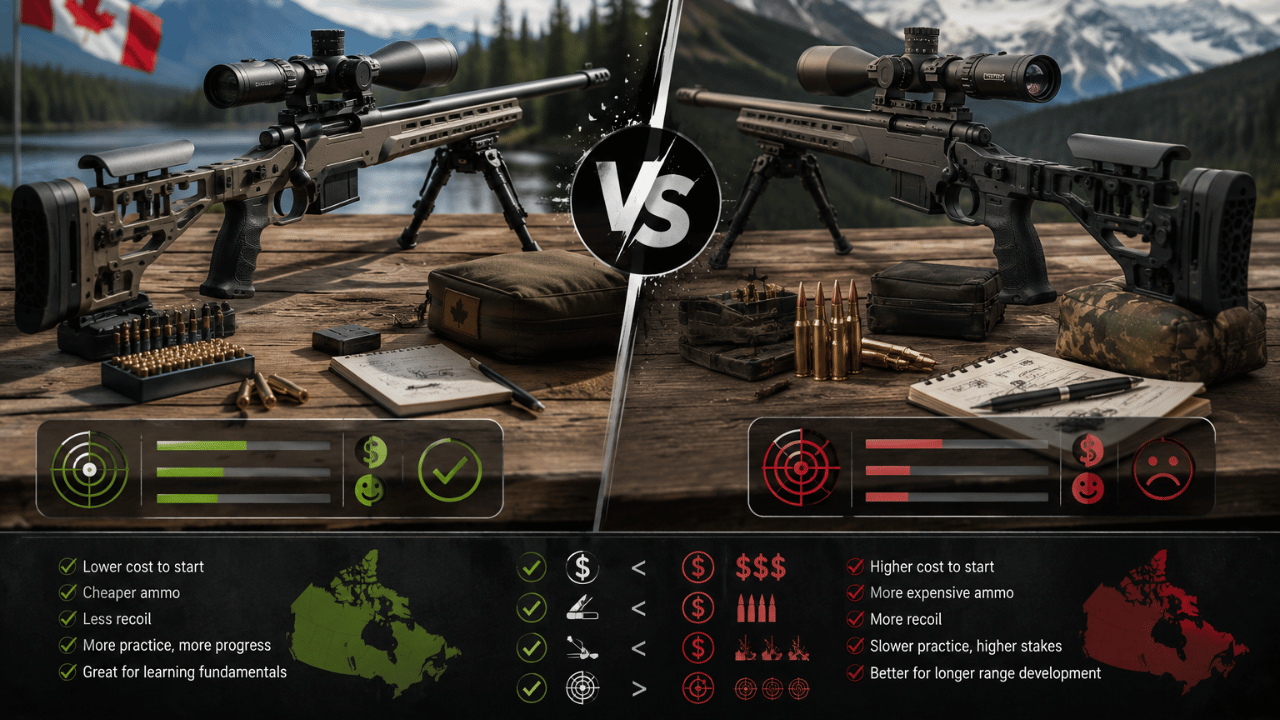
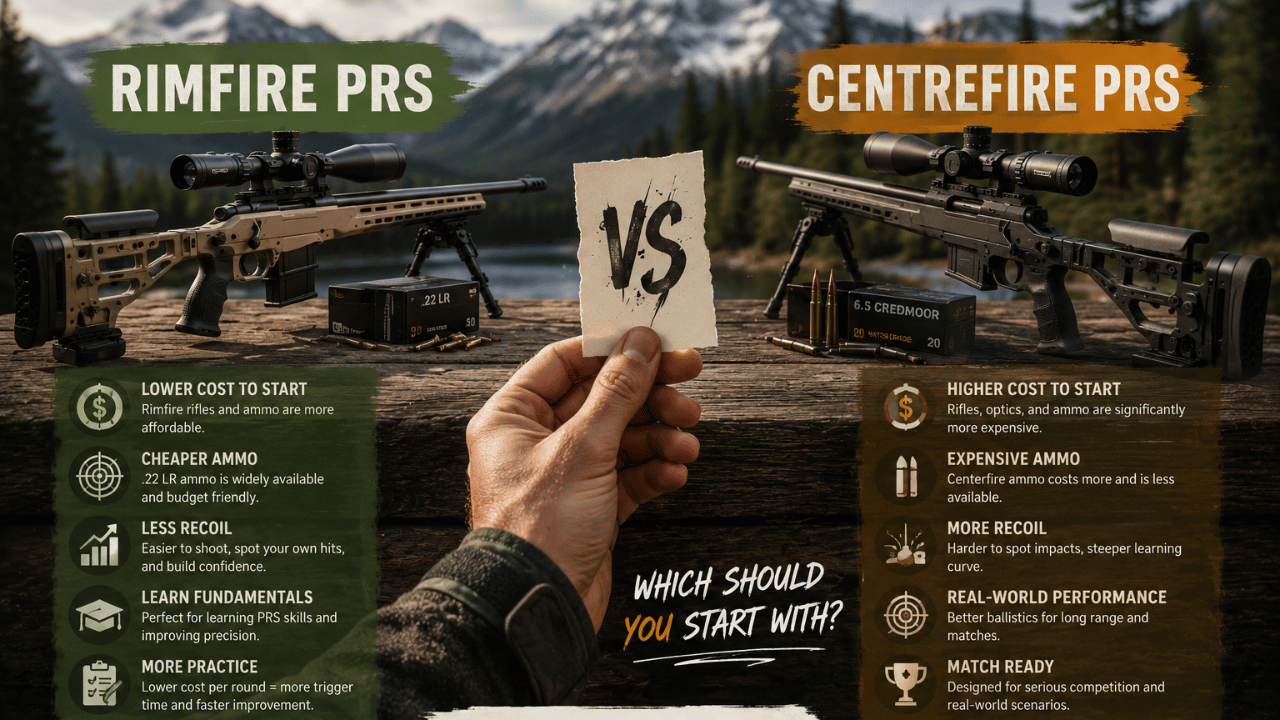
| Start with PRS Rimfire (CRPS). The Canadian shooting community on CanadianGunNutz consistently advises beginners to start rimfire — the fundamentals are identical at 100m with a .22 LR as at 500m+ with a centrefire, and the cost difference is enormous. A complete CRPS Production-division setup costs $1,200–$1,800 CAD. An equivalent centrefire PRS-ready setup costs $4,000–$7,000+ CAD. Start rimfire, build your skills, transfer to centrefire when you know exactly what you need. |
| Key Facts: .22 LR ammunition Canada: ~$60–$80 per 500 rounds (Ammo Supply Canada, 2025)• 6.5 Creedmoor match ammo Canada: ~$60–$80 per 20 rounds — roughly 25x the cost per round• CRPS Production division rifle + optic budget: ~$1,600 USD combined• Entry-level centrefire PRS setup (Savage 110 Elite Precision + scope + mount): ~$3,400–$4,000+ CAD• Skill transfer: fundamentals learned at 100m rimfire transfer directly to 500m+ centrefire• CRPS is a federally registered non-profit — matches held across Canada in 2026 |
What Is PRS Rimfire vs PRS Centrefire?
PRS Rimfire (CRPS in Canada)
PRS Rimfire uses .22 LR bolt action rimfire rifles to engage steel targets at distances from 25 to 350 metres, shooting from varied unconventional positions under time pressure. In Canada, this is governed by the Canadian Rimfire Precision Series (CRPS) — a federally registered non-profit that runs matches across the country. CRPS has aligned its rules with the international PRS Rimfire ruleset, allowing Canadian competitors to earn PRS points. The CRPS Production division caps the combined rifle and optic cost, keeping the entry barrier low for beginners.
PRS Centrefire
PRS Centrefire uses full-size centrefire bolt action rifles — predominantly 6.5 Creedmoor, .308 Winchester, and 6mm Creedmoor — to engage steel targets at distances from 100 to 1,000+ metres. This is full-size Precision Rifle Series competition. The equipment costs are significantly higher, the range requirements are more demanding, and the skill ceiling is considerably higher. Most sanctioned PRS matches in Canada require a centrefire rifle.
The Real Cost Difference — Rimfire vs Centrefire in Canada
| Cost Category | PRS Rimfire (CRPS) | PRS Centrefire |
| Entry rifle | ~$600–$900 CAD (CZ 457 LRP / Ruger Precision Rimfire) | ~$2,300–$3,500 CAD (Savage 110 Elite Precision / Tikka T3x TAC A1) |
| Entry scope | ~$400–$600 CAD (Vortex Diamondback Tactical) | ~$800–$1,500 CAD (Vortex Viper PST Gen II minimum) |
| Total entry setup | ~$1,200–$1,800 CAD | ~$3,400–$6,000+ CAD |
| Ammunition per session (100 rounds) | ~$12–$16 CAD (.22 LR) | ~$300–$400 CAD (6.5 Creedmoor match) |
| Annual ammo cost (1,500 rounds) | ~$180–$240 CAD | ~$4,500–$6,000 CAD |
| Reloading option | ⚠️ Not available — rimfire not reloadable | ✅ Yes — reduces cost to ~$0.60–$0.90/round |
| Match fees | ~$40–$80 CAD per match (similar) | ~$50–$100 CAD per match (similar) |
| Required range distance | 25–350m (most Canadian clubs) | 100m–1,000m+ (limited clubs) |
| Bottom Line on Cost: A beginner who starts centrefire PRS and shoots 1,500 rounds in their first year will spend approximately $5,000–$7,000 CAD on ammunition alone — on top of the $4,000–$6,000 setup cost. A rimfire beginner spends $200–$250 on ammunition and $1,500 on setup. The skill development per dollar is dramatically better in rimfire. |
Do Rimfire Skills Actually Transfer to Centrefire PRS?
This is the most important question — and the answer, as the Canadian shooting community on CanadianGunNutz consistently confirms, is yes, completely. The fundamental skills of precision rifle shooting are identical at every distance and calibre:
- Trigger control — A clean break is a clean break whether you are shooting .22 LR at 100m or 6.5 Creedmoor at 500m
- Position building — Setting up a stable prone position with shooting bags is the same mechanical process regardless of calibre
- Wind reading — .22 LR drifts more than centrefire at equivalent distances, meaning rimfire shooters develop heightened wind sensitivity that is directly applicable to centrefire
- Bag transitions — Moving between positions quickly and efficiently is a physical skill that transfers completely
- Stage planning — Reading a stage brief and building a shooting plan is identical format in both disciplines
- Scope operation — Dialling elevation, using holdovers, managing parallax — all identical skills
As one experienced member of the Canadian precision rifle community noted: ‘The fundamentals of rifle shooting are the same at 100 metres with a rimfire as at half a kilometre or beyond with a centrefire, and far less hiking to change targets. And .22 LR is a whole lot cheaper. You need to send a lot of ammo downrange as you’re learning to shoot well.’
Range Access in Canada — A Critical Practical Consideration
Centrefire PRS requires ranges with target distances from 400 to 1,000 metres. These ranges exist in Canada but are not universally accessible to all shooters in all provinces. A dedicated PRS-capable range in Ontario, for example, may have a significant wait-list, drive distance, or membership requirement that limits weekly practice access.
PRS Rimfire matches in Canada operate effectively at 100–350 metres — distances that most Canadian outdoor ranges accommodate. The vast majority of Canadian shooting ranges can host CRPS-format matches without any special infrastructure, meaning local club-level competition is accessible in most provinces. For a beginner building fundamentals, weekly practice at a local 100-metre range with a rimfire rifle produces faster skill development than monthly visits to a long-range centrefire facility.
Best Rifles for Each Path — Canadian Market 2026
PRS Rimfire — Top Picks in Canada
| Rifle | Price (CAD) | Division | Standout Feature |
| Ruger Precision Rimfire | ~$600–$750 | Production | AR-style adjustable chassis, familiar ergonomics |
| CZ 457 LRP | ~$850–$950 | Production | Match chamber, 20″ fluted barrel — best inherent accuracy |
| Tikka T1x | ~$700–$800 | Production | Smooth T3x-style action in rimfire — excellent trigger |
| CZ 457 MTR | ~$800–$900 | Production | Match chamber in different stock — same accuracy as LRP |
| Vudoo V-22 | ~$2,500+ | Open | Premium competition rimfire — for serious Open division |
PRS Centrefire — Entry Level Picks in Canada
| Rifle | Price (CAD) | Notes |
| Savage 110 Elite Precision | ~$2,300 | Best value centrefire PRS entry — chassis, heavy barrel, AccuTrigger |
| Ruger Precision Rifle | ~$1,800 | Affordable chassis rifle — good starting point for centrefire |
| Tikka T3x TAC A1 | ~$2,400 | Finnish quality chassis rifle — smooth action, excellent trigger |
| Bergara B-14 HMR | ~$1,600 | Non-chassis option — hybrid hunter/precision platform |
When Does It Make Sense to Start With Centrefire Directly?
Rimfire is the right starting point for most Canadian beginners — but there are specific situations where going directly to centrefire makes sense:
- You reload centrefire ammunition — at $0.60–$0.90 per round reloaded, the cost gap between rimfire and centrefire narrows dramatically and centrefire’s skill ceiling becomes immediately accessible
- You already have significant precision rifle experience — military, law enforcement, or dedicated long-range hunting background means fundamentals are already established
- You have access to a 600+ metre range regularly — if your home club has a 600m or 800m range you can use weekly, going directly to centrefire maximises that infrastructure
- Budget is not a constraint — if $5,000–$8,000 entry cost and $400/session ammunition costs are genuinely not limiting factors, centrefire’s higher skill ceiling pays off faster
What Equipment Carries Over From Rimfire to Centrefire?
One of the most practical advantages of starting rimfire is that a significant portion of your equipment investment transfers directly to centrefire. Your shooting bags are identical in both disciplines — the same front bag and rear bag you use for CRPS rimfire matches will serve you in centrefire PRS without any modification. Your stage planning skills, position habits, and match experience transfer completely.
Optics are the one significant consideration. A scope purchased specifically for rimfire at short parallax settings may not perform optimally at centrefire PRS distances. The advice from experienced Canadian PRS shooters is to buy a scope with sufficient parallax adjustment range (10m minimum on the close end, 500m+ on the far end) that can serve both rimfire and future centrefire use. A first focal plane scope in the 5-25x or 4-20x range with exposed turrets — see our guide on the best rifle scope for Canadian precision shooting — satisfies both rimfire and centrefire requirements.
CRPS Matches in Canada — Where to Find Them
- British Columbia — Vancouver Island (Nanaimo, Victoria area ranges) — established CRPS match calendar
- Alberta — Growing precision rimfire community, multiple club-level leagues in Calgary and Edmonton regions
- Ontario — Expanding match calendar, provincial federation support for rimfire precision formats
- Quebec — Active francophone shooting community, CRPS matches growing in Montréal-area clubs
The CRPS website (rimfireprecision.ca) maintains a current match calendar. Most clubs also run informal club-level rimfire leagues using the CRPS format before competitors progress to full sanctioned CRPS matches.
Frequently Asked Questions
Q: Is PRS Rimfire easier than centrefire PRS?
A: Yes and no. PRS Rimfire stages are shorter in distance (25–350m vs 100–1,000m+), but the .22 LR’s dramatic wind sensitivity and bullet drop at range creates unique challenges that actually build wind-reading skills faster than centrefire at equivalent beginner skill levels. The stage format, positions, and time pressure are essentially identical. Many experienced centrefire PRS competitors describe their rimfire results as humbling — the skills are genuinely demanding at any level.
Q: Can I use my centrefire PRS scope on a rimfire rifle?
A: Yes, with one consideration. A centrefire PRS scope with a parallax adjustment range of 10m–infinity will work on a rimfire rifle at 100–300m when set to the appropriate parallax setting. This is actually the recommended approach — buying a centrefire-capable scope first (FFP, exposed turrets, MRAD reticle, 4-20x or 5-25x) and using it on your rimfire until you acquire a centrefire rifle. This avoids buying two separate optic systems.
Q: How long should I shoot rimfire before moving to centrefire PRS?
A: Most experienced Canadian PRS competitors suggest competing in rimfire for at least one full match season (typically 6–10 matches) before transitioning to centrefire. At this point, you will have a clear understanding of what equipment you actually need, what your genuine weaknesses are to address, and whether centrefire competition matches your lifestyle and budget. Skipping rimfire and starting centrefire directly often results in expensive equipment decisions made without the knowledge to make them correctly.
Q: Is the CZ 457 LRP the best rifle for CRPS Production division?
A: The CZ 457 LRP is widely considered the top accuracy-per-dollar option for CRPS Production division due to its Match chamber and purpose-built competition configuration. The Tikka T1x and Ruger Precision Rimfire are competitive alternatives. The T1x offers the smoothest action of the three; the Ruger Precision Rimfire provides the most AR-style ergonomics and adjustability. All three are excellent choices within Production division budget constraints.
Q: Can I hunt small game with the same rifle I use for CRPS competition?
A: Yes. A CZ 457 LRP or Tikka T1x in .22 LR is a fully functional small game and varmint hunting platform alongside its competition role. The Match chamber on the LRP is slightly more ammunition-sensitive than a Sporting chamber model, but shoots most quality hunting ammunition adequately. Using one rifle for both hunting and competition is a practical cost-saving approach that many Canadian rimfire shooters take.
The Bottom Line — Start Rimfire, Transition When Ready
For the vast majority of Canadian beginners, PRS Rimfire through the CRPS is the correct starting point. The cost advantage is enormous, the range access is better, the skill transfer is complete, and the competitive environment is welcoming to new shooters. Browse bolt action rimfire rifles at Victory Ridge Sports to find a Production-division-eligible platform, read our complete PRS Rimfire getting started guide for the full equipment breakdown, and see our PRS shooting guide for the centrefire path when you are ready to make the transition.