
Choosing between slugs and buckshot is one of the most common questions Canadian deer hunters ask before shotgun season. Both are effective at close range, but they differ significantly in effective range, accuracy, and where they are legal to use. This guide explains slug vs buckshot for deer in Canada for 2026 – covering effective range, patterns, provincial regulations, and how to match your load to your shotgun – so you can make an ethical, informed choice for your hunt.
| Quick Answer: For most Canadian deer hunters, a slug is the better all-round choice – it is accurate and effective on deer out to roughly 100 metres from a smoothbore and further from a rifled barrel. Buckshot is best reserved for very close shots inside about 25-35 metres in thick cover. Some provinces and zones also restrict buckshot size or ban it outright for deer, so slugs are the safer default. Always confirm your provincial regulations and the minimum legal buckshot size before hunting. |
| Important – Check Your Regulations: Hunting laws, legal ammunition, shotgun-only zones, and season dates vary by province and Wildlife Management Unit and change year to year. This article is general information, not legal advice. Always confirm the current rules with your provincial regulator (for example, the Ontario Hunting Regulations Summary) before hunting. |
What Is the Difference Between a Slug and Buckshot?
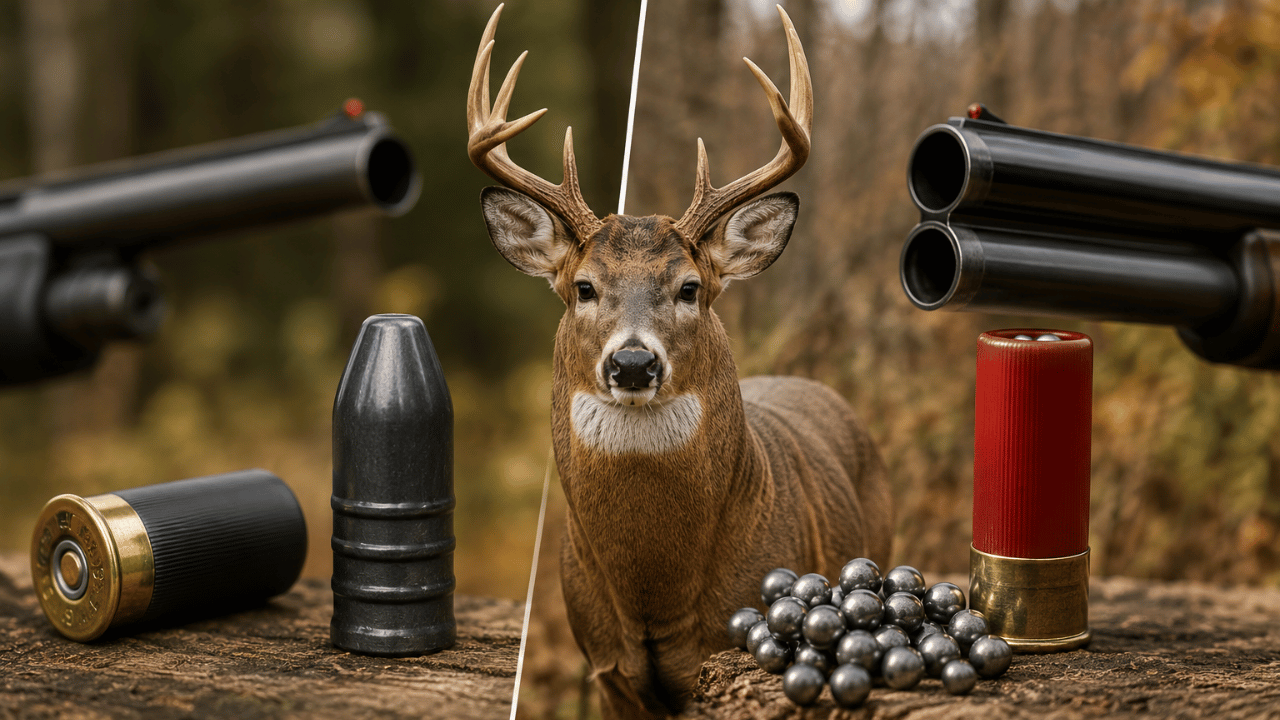
A slug is a single, heavy projectile that turns a shotgun into a short-range rifle, while buckshot is a shell loaded with several large lead pellets that spread into a pattern. The core trade-off is range versus spread: a slug delivers one accurate hit at distance, while buckshot delivers multiple pellets that are only reliable up close.
This single difference drives every other decision – effective range, accuracy, ethical shot distance, and which is legal in your area. Understanding how each behaves helps you pick the right load for the terrain and range you expect to hunt.
Slug vs Buckshot for Deer – Side-by-Side Comparison
Slugs offer more range and accuracy; buckshot offers more forgiveness at very close range. The table below compares the two for Canadian deer hunting.
| Factor | Slug | Buckshot |
|---|---|---|
| Projectile | Single heavy slug | Multiple large pellets |
| Effective range | ~100 m smoothbore, more if rifled | ~25-35 m |
| Accuracy | High – aimed like a rifle | Lower – pattern spreads |
| Best terrain | Open woods, fields, stands | Thick brush, close blinds |
| Legal notes | Widely allowed for deer | Restricted/size-limited in places |
| Recoil | Heavy | Heavy |
When Should You Use a Slug for Deer?
Use a slug when you may take shots beyond about 30 metres, hunt open woods or fields, or want the most accurate, ethical option. Slugs are the default choice for most Canadian deer hunters because they extend usable range well past what buckshot can offer while allowing a precise, aimed shot at the vitals.
Rifled slugs vs sabot slugs
Match the slug to your barrel. Rifled (Foster-type) slugs are designed for the smoothbore barrels most shotguns use and are effective on deer inside roughly 100 metres. Sabot slugs are made for rifled barrels and, with a rifled slug gun, can be accurate to 150 metres or more. Using the wrong slug for your barrel reduces accuracy, so confirm whether your barrel is smoothbore or rifled first.
Sighting in your slug gun
Many shotgun barrels send slugs slightly off the bead’s point of aim, and that deviation grows with distance. Always pattern and sight-in your specific shotgun with your chosen slug at the range before the season, using short shooting sessions to manage recoil. This is the single most important step for an ethical harvest.
When Should You Use Buckshot for Deer?
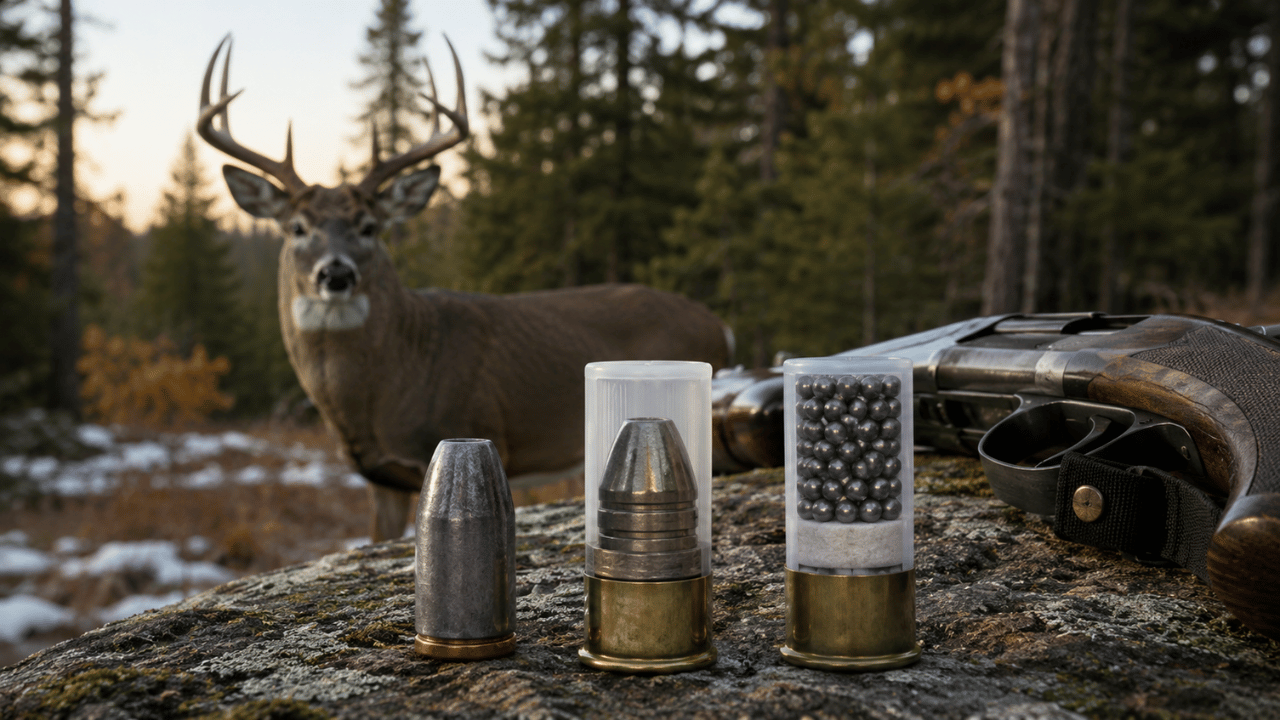
Use buckshot only for close-range shots in thick cover, typically inside 25-35 metres, and only where it is legal. Buckshot’s advantage is multiple pellets that can find a gap through light brush and forgive a slightly imperfect close-range shot, but its pattern opens quickly, making longer shots unreliable and potentially unethical.
In Canada, buckshot size is often regulated. Ontario, for example, requires #1 buck or larger for deer, and smaller sizes such as #2 buck are not legal. Where buckshot is permitted, use the largest size that patterns well in your gun – commonly #1, #0, 00, or 000 buck – and test the pattern at your expected shot distance before hunting.
| Ethical Range Note: Buckshot is best kept to shots inside about 25-35 metres. Beyond that, the pattern opens enough that pellets can wound rather than cleanly harvest. If you cannot reliably keep your shots close, a slug is the more ethical choice. |
Is Buckshot Legal for Deer in Canada?
Buckshot legality for deer depends on your province and, in some cases, the specific Wildlife Management Unit. Some areas allow buckshot at or above a minimum pellet size, others restrict deer hunting to slugs only, and shotgun-only zones exist in parts of southern Ontario and elsewhere.
As a notable example, Ontario prohibits buckshot for deer altogether – hunters must use single-projectile ammunition (slugs), with a 20-gauge minimum, and many southern Wildlife Management Units are shotgun-only zones. Other provinces set their own rules, some allowing buckshot above a minimum size. Because these regulations change and vary locally, you must check your official provincial hunting summary before choosing a load.
You can read Ontario’s current rules in the official Ontario Hunting Regulations Summary on the Government of Ontario website. When in doubt, a slug is legal in more places and is the safer default.
Which Shotgun Is Best for Deer in Canada?
The best deer shotgun is one you can shoot accurately with your chosen load, in a barrel type that matches your ammunition. A smoothbore pump or semi-auto with a rifled choke or slug barrel suits most Canadian hunters using Foster slugs, while a dedicated rifled-barrel slug gun maximizes range with sabot slugs.
A reliable pump-action shotgun is a proven, budget-friendly deer platform, while a semi-auto hunting shotgun reduces felt recoil and speeds follow-up shots. Browse the full range of shotguns in Canada and the Canuck shotguns lineup to find a deer-capable gun to suit your budget.
Slug vs Buckshot for Deer – The Bottom Line
For most Canadian deer hunters, a slug is the better all-round choice, offering greater range, accuracy, and legality across more areas. Reserve buckshot for close-range shots in heavy cover where it is legal and where you can keep every shot inside about 25-35 metres.
Whichever you choose, the two non-negotiables are the same: confirm your provincial regulations, and pattern or sight-in your specific shotgun and load before opening day. Doing both ensures a legal, ethical, and confident harvest. Keep spare shells handy with a
Keep spare shells within reach using a side saddle shell carrier so you can switch between slug and buckshot loads quickly in the field.
Frequently Asked Questions
Q: Is a slug or buckshot better for deer hunting in Canada?
A: For most Canadian deer hunters, a slug is better because it is accurate and effective on deer out to roughly 100 metres from a smoothbore and further from a rifled barrel. Buckshot is only reliable at close range, inside about 25-35 metres in thick cover. Slugs are also legal in more provinces and zones. Choose buckshot only for very close shots where it is permitted and where you can keep every shot tight.
Q: Is buckshot legal for deer in Ontario?
A: In Ontario, buckshot is legal for deer only in #1 buck size or larger; smaller sizes such as #2 buck are not permitted. Ontario also designates certain areas as shotgun-only for big game. Regulations vary by Wildlife Management Unit and change year to year, so always confirm the current Ontario Hunting Regulations Summary before hunting. Where you are unsure, a slug is legal in more areas and is the safer choice.
Q: What is the effective range of a 12 gauge slug on deer?
A: A 12 gauge Foster (rifled) slug from a smoothbore barrel is effective on deer to roughly 100 metres. A sabot slug fired from a rifled slug-gun barrel can be accurate to about 150 metres or more. Beyond these ranges, energy and accuracy drop off, and a centrefire rifle is the better tool where it is legal. Always sight-in your specific gun and slug, as point of impact varies between barrels.
Q: Do I need a rifled barrel to hunt deer with slugs?
A: No. A rifled barrel is not required. Most shotguns have smoothbore barrels, which work well with rifled (Foster-type) slugs on deer inside about 100 metres. A rifled barrel improves accuracy and extends range but requires sabot slugs, which are more expensive. Match your slug type to your barrel: rifled/Foster slugs for smoothbore, sabot slugs for rifled barrels.
Q: What size buckshot is best for deer?
A: Where buckshot is legal for deer, use the largest size that patterns well in your shotgun – commonly #1, #0, 00, or 000 buck. Larger pellets carry more energy but fewer pellets per shell, so pattern-test at your expected shot distance to find the best balance. In Ontario, the minimum legal size is #1 buck. Always check your provincial minimum size and confirm buckshot is permitted in your area before hunting.
Shop Deer Hunting Shotguns at Victory Ridge Sports
Victory Ridge Sports in Barrie, Ontario carries a full range of shotguns in Canada suited to deer hunting, including reliable pump-action shotgun models and the Canuck shotguns lineup. Whether you run slugs or buckshot, pair the right gun and load with proper sight-in for a confident, ethical season.