A young hunter in the shop last fall told me he had shot his first deer that season, then corrected himself halfway through the sentence and said moose instead.
His buddy laughed at him. I told him he had actually been right the first time. A moose is a deer, and so are elk and caribou, and that surprises almost everyone who has not spent time with a field guide. It also matters more than it sounds, because the five deer species in this country sit under completely different rules. One of them you can hunt in every province. One of them you can barely hunt anywhere.
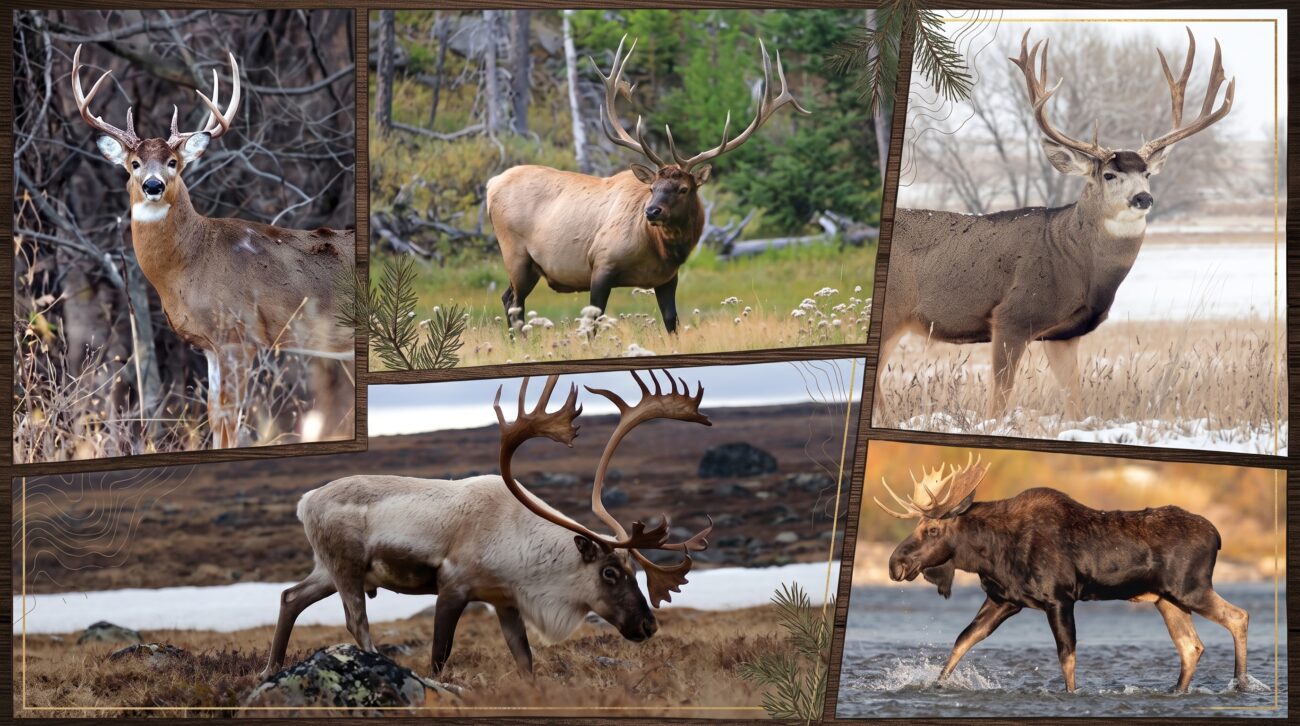
Direct answer: Canada has five native deer species: white-tailed deer, mule deer, elk, moose, and caribou, with black-tailed deer counted as a subspecies of mule deer. White-tailed deer and moose are widely huntable. Mule deer and elk are mostly western. Caribou hunting is closed across most of the country, and introduced fallow deer live in parts of BC.
The Deer Most Canadians Hunt
Two species in the genus Odocoileus account for most of the deer hunting in Canada. They look similar at a distance and differ sharply up close, and where you live largely decides which one you meet.
Here’s how to tell them apart:
White-tailed deer
The white-tailed deer is the most widespread and most hunted big game animal in the country, ranging across southern Canada from British Columbia to Nova Scotia. Its tail is brown on top and bright white underneath, flashed upright when the deer runs. A whitetail buck’s tines rise individually off a single main beam. Canadian whitetails also run heavy by continental standards, as our breakdown of how much a buck weighs in Canada explains.
Mule deer
Mule deer belong to western Canada, mostly British Columbia, Alberta, and Saskatchewan, and Ontario hunters will not find them at home. They carry large, mule-like ears, a narrow white tail tipped in black, and antlers that fork into a Y rather than growing tines off one beam. They also bound with all four feet leaving the ground at once, a gait called stotting.
Black-tailed deer
Black-tailed deer live along the BC coast, on Vancouver Island, and on most coastal islands. They count as a subspecies of mule deer rather than a separate species, which is why BC regulations group them together as mule (black-tailed) deer. Where the two ranges overlap, hybrids occur.
The Giants of the Deer Family
The two largest members of the Canadian deer family rarely get called deer at all. Both share the same family, Cervidae, and both shed and regrow antlers every year.
Here’s what to know about each:
Elk
Elk, also called wapiti, live mainly in western Canada, with strong populations in Alberta and British Columbia and huntable herds in Saskatchewan and Manitoba. Ontario also holds a reintroduced herd and runs a small, resident-only draw in a handful of units around Bancroft and North Hastings. Bulls carry sweeping antlers and bugle loudly through the fall rut.
Moose
Moose are the largest deer on the planet and range across nearly every province, from the BC interior to Newfoundland, where they were introduced more than a century ago. Most provinces allocate moose tags through a draw, and our guide to how the Ontario moose draw and tag system works covers how that works here. Nova Scotia restricts its moose hunt to Cape Breton Island, since the province protects its mainland moose as endangered.
Caribou, the Deer Most Hunters Cannot Hunt
Caribou are the one Canadian deer where the legal answer is mostly no. The reasons tell you a lot about how the species is doing.
Here’s where things stand:
Why caribou are protected
Caribou include several subspecies, among them boreal woodland caribou, barren-ground caribou, and Peary caribou, and many Canadian populations are listed as at risk under the federal Species at Risk Act. Boreal and southern mountain caribou have carried a threatened listing federally since 2003, and Ontario protects boreal caribou as threatened under its own Endangered Species Act.
Where caribou hunting has closed
Ontario does not offer caribou hunting. Quebec has banned hunting of its forest-dwelling caribou since 2001, closed sport hunting of the George River herd in the early 2010s, and ended sport hunting of the Leaf River herd after the 2017-18 season. The Northwest Territories closed barren-ground caribou sport hunting in 2015.
Where limited hunting remains
Some caribou hunting does continue. Newfoundland still offers limited woodland caribou hunting, and outfitters report open seasons on the Qamanirjuaq herd in northern Manitoba and in parts of central Nunavut. These hunts carry tight quotas and change with herd surveys, so confirm current status directly with the province or territory before planning one.
Introduced Deer Species in Canada
Not every deer in Canada belongs here. A few species arrived through estates and hunting introductions, and the rules for them run very differently.
Here’s what to know:
Fallow deer in British Columbia
Fallow deer, a European species with spotted adult coats and palmated antlers on mature bucks, were introduced to a private estate on James Island near Victoria in 1908. They swam to nearby Sidney Island and now live across parts of the Gulf Islands and southern Vancouver Island. In BC management units 1-1 to 1-7, fallow deer reportedly have no closed season, no bag limit, and require no species licence.
Why exotic deer get liberal rules
Introduced deer compete with native wildlife and can damage island ecosystems that evolved without them, which is why management favours reducing their numbers rather than protecting them. Sidney Island has also been the focus of an ecological restoration project aimed at removing introduced fallow deer. Confirm the current rules in the BC synopsis before you hunt them, since restoration work can change access.
Which Deer You Can Hunt, Province by Province
The species list matters less to most hunters than the practical question of what they can actually tag where they live.
Here’s a quick reference:
| Species | Where found | Can you hunt it? |
| White-tailed deer | Southern Canada, BC to Nova Scotia | Yes, across its range |
| Mule deer | BC, Alberta, Saskatchewan | Yes, in the west |
| Black-tailed deer | BC coast and islands | Yes, as mule (black-tailed) deer |
| Elk | Western provinces, small Ontario herd | Yes, often by draw |
| Moose | Nearly every province | Yes, usually by draw |
| Caribou | Boreal, mountain, and Arctic regions | Mostly closed, limited exceptions |
| Fallow deer | Gulf Islands, southern Vancouver Island | Yes, in BC units 1-1 to 1-7 |
What it means for Ontario hunters
Ontario hunters can pursue white-tailed deer, moose by draw, and elk through a small resident-only draw. Mule deer, black-tailed deer, and fallow deer require travel west, and caribou are closed in Ontario. For most Ontarians, whitetail is the starting point, and our guide to Ontario deer tags and what they cover walks through it.
Every province licenses its own deer
A licence from one province never covers another. Hunting mule deer in Alberta or black-tailed deer in BC requires that province’s licences, and non-residents often face guide requirements on top. The Canadian Encyclopedia offers a solid overview of deer in Canada for anyone wanting the full biology.
Gearing Up for Whatever You Hunt
From an Ontario whitetail in the cedars to a mule deer on an Alberta coulee, each species asks for a slightly different approach and a slightly different kit.
We run a Canadian hunting and target sports store in Barrie, Ontario, at 431 Bayview Drive, and we ship across Canada. We stock rifles, shotguns, and archery gear, plus optics, rangefinders, packs, knives, blaze orange, and the layering systems that handle everything from a cedar swamp to an open prairie.
Most of the people behind our counter hunt hard themselves, and several have chased deer in more than one province. Visit the Barrie showroom Monday through Saturday, call 1-705-252-4400, or order online with free shipping over $250.
Frequently Asked Questions
How many types of deer are in Canada?
Canada has five native deer species: white-tailed deer, mule deer, elk, moose, and caribou. Black-tailed deer are a subspecies of mule deer, and introduced fallow deer live in parts of British Columbia.
Is a moose a deer?
Yes. Moose belong to the deer family, Cervidae, along with elk, caribou, white-tailed deer, and mule deer. The moose is the largest member of the deer family in the world.
Can you hunt caribou in Canada?
In most places, no. Ontario and Quebec have closed caribou hunting, and the Northwest Territories closed barren-ground sport hunting in 2015. Limited hunting continues in Newfoundland and parts of northern Manitoba and Nunavut.
What is the difference between a mule deer and a whitetail?
Mule deer have large ears, a black-tipped tail, and antlers that fork into a Y. White-tailed deer have a broad tail that is white underneath and antler tines rising individually off a single main beam.