
Few debates in the hunting world are as timeless as lever action vs bolt action. One is the fast-handling, brush-country classic that helped tame the West; the other is the precision workhorse trusted by snipers and long-range hunters for over a century. Both have earned their place in the safe, and both are still fantastic hunting rifles in 2026. But they’re built for different jobs, and choosing the wrong one for your hunt can leave you frustrated in the field.
In this blog post we will break down how each action works, their honest strengths and trade-offs, and exactly how to match the right rifle to your terrain, your game, and your style. We’ll also look at how the modern lever action has closed much of the traditional gap, and which Canadian-made options deliver the best of both worlds.
How Each Action Works?
Before comparing strengths and weaknesses, it helps to understand the fundamental mechanical difference between these two platforms, because that difference drives everything else. The way each rifle chambers a round, locks up, and ejects a spent casing shapes how fast it cycles, how accurate it is, and how it handles in the field. Both are manually operated repeaters, meaning you cycle the action by hand between shots, but they do it in very different ways. Understanding these mechanics makes the pros and cons that follow much easier to grasp. Here’s how each one functions.
How a Lever Action Works?
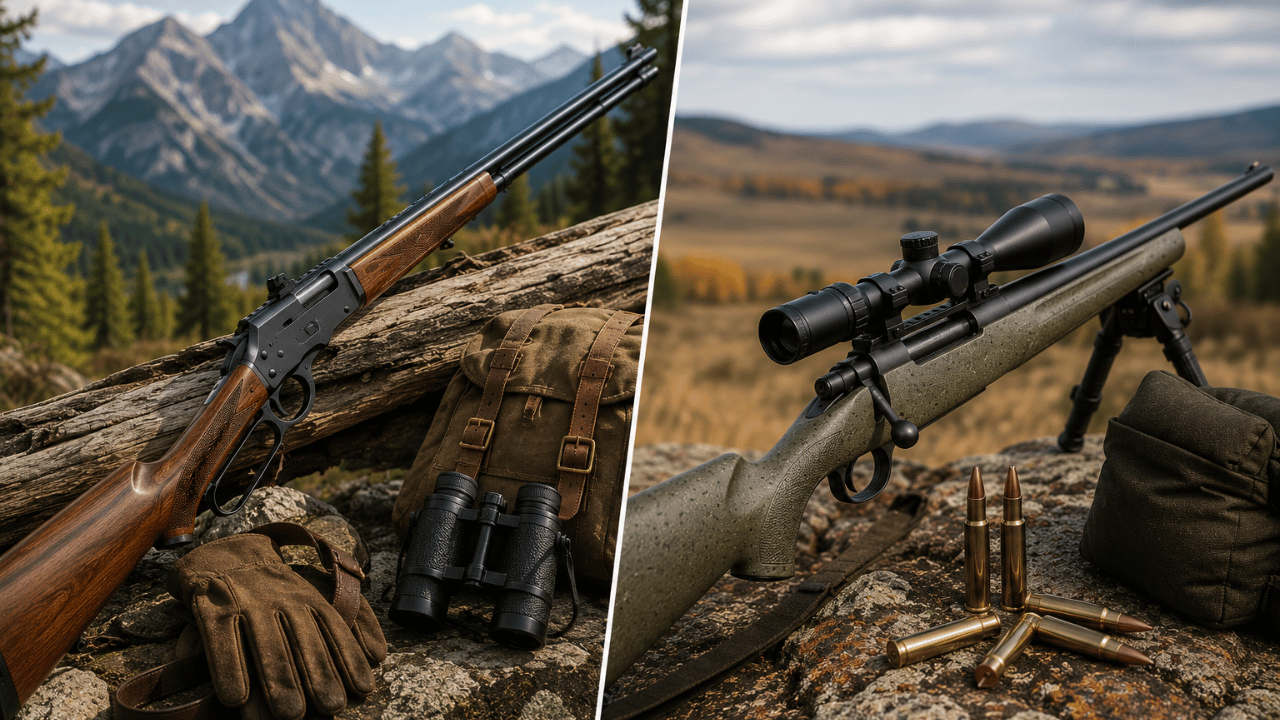
A lever action uses a lever loop located behind the trigger guard. When you cycle the lever down and forward, the action ejects the spent casing, and as you return the lever, a fresh cartridge is lifted from the tubular magazine and chambered while the hammer cocks. The entire motion is smooth, fast, and can be performed without taking the rifle off your shoulder or losing your sight picture, which is what makes lever guns so quick for follow-up shots.
How a Bolt Action Works?
A bolt action uses a manually operated bolt handle. You lift the handle, pull it rearward to eject the spent casing, push it forward to strip a fresh round from the magazine, and turn it down to lock the bolt solidly into the receiver. That rigid lockup, with no moving parts during firing other than the trigger and firing pin, is exactly what gives the bolt action its legendary accuracy. The trade-off is that the motion is slower and requires you to break your firing position slightly between shots.
Lever Action Rifles: Strengths and Trade-Offs
The lever action has endured for more than 150 years for good reason, and it remains one of the most beloved hunting platforms in North America. Its appeal isn’t just nostalgia, though the classic looks certainly help. The lever gun offers real, practical advantages in the specific conditions it was designed for, which is why more whitetails have been taken with lever-action .30-30s than arguably any other rifle. That said, the design does come with genuine limitations that are important to understand before you buy.
Here’s an honest look at both sides:
Where Lever Actions Excel (Speed, Handling, Brush)
Lever actions shine in fast, close-range situations. They cycle quickly for rapid follow-up shots, their compact overall length and flat-sided receivers make them easy to carry and manoeuvre through thick brush, and they shoulder and point intuitively. A lever gun slides easily into a truck or a saddle scabbard, sits nicely in the hand, and comes up fast when a deer steps out at 40 yards in heavy cover. For stalking, still-hunting, and any scenario where speed and handling matter more than long-range precision, the lever action is hard to beat.
The Trade-Offs to Know (Range, Optics, Ammo)
The traditional lever action’s main limitation is accuracy at distance. The two-piece stock, rear-locking bolt, and barrel-mounted magazine bands don’t lend themselves to the same precision as a bolt gun, and most lever guns are best inside 150 to 200 yards. Tubular magazines also traditionally require flat-point or round-nose bullets to prevent the pointed tip of one cartridge from contacting the primer of the round ahead of it. Older top-ejecting models could also make scope mounting awkward, though modern designs have largely solved this.
Bolt Action Rifles: Strengths and Trade-Offs
The bolt action is the gold standard for precision, and it has been the choice of military snipers and serious long-range hunters for well over a century. Its rugged simplicity and inherent accuracy make it the default recommendation for anyone whose primary concern is putting a bullet exactly where they aim at distance. But like any design, it involves trade-offs, and those trade-offs matter depending on how you hunt. A bolt action isn’t automatically the right choice just because it’s more accurate on paper. Here’s an honest look at what it does well and where it gives ground.
Where Bolt Actions Excel (Accuracy, Range, Versatility)
The bolt action’s biggest advantage is accuracy. Its rigid lockup and minimal moving parts during firing produce highly consistent shot placement, and the design allows the barrel to be free-floated for even better precision. Bolt actions also support a far wider range of high-powered cartridges, from mild .243 up to hard-hitting magnums for elk, moose, and bear, and they’re easy to mount with quality optics. For open-country hunting, long-range shots, and taking large or tough game at distance, the bolt action is the clear choice. If you want to explore how a bolt action stacks up against other platforms, see our guide on bolt action vs semi-auto rifles.
The Trade-Offs to Know (Speed, Profile)
The bolt action’s precision comes at the cost of speed. Cycling the bolt is slower than working a lever, and it requires you to break your firing position slightly between shots, which can cost you a fast follow-up on running or quickly disappearing game. Bolt actions also tend to be longer and bulkier than lever guns, which makes them less handy in tight brush and thick timber. For close-range, fast-moving scenarios, the bolt gives up ground to the lever.
Lever vs Bolt at a Glance
Sometimes the clearest way to compare two platforms is side by side. The table below distills everything covered above into a quick reference so you can weigh the factors that matter most to your hunting style at a glance.
| Factor | Lever Action | Bolt Action |
| Cycling Speed | Fast | Slower |
| Accuracy | Good (short-mid range) | Excellent (all ranges) |
| Effective Range | ~150–200 yards | 300+ yards |
| Handling in Brush | Excellent, compact | Bulkier, longer |
| Optics Mounting | Good on modern models | Excellent |
| Caliber Options | Traditional, growing | Very wide |
| Best For | Bush, close range, fast follow-ups | Open country, precision, big game |
The Modern Lever Action: Closing the Gap
Here’s what most lever-vs-bolt comparisons miss: the lever action of 2026 is not the lever action of 1894. There’s been a massive resurgence in modern, tactical-style lever guns that keep the classic fast-handling advantages while erasing many of the traditional weaknesses. If your only picture of a lever gun is a wood-stocked cowboy rifle, you’re missing how far the platform has come, and how competitive it now is with a bolt action for many Canadian hunting scenarios. Here’s what changed.
M-LOK, Rails, and Optics-Ready Receivers
Modern lever actions now feature M-LOK handguards, Picatinny rail sections, and side- or flat-top receivers designed for easy optics mounting. That means you can run a red dot, LPVO, or traditional scope on a lever gun as easily as on a bolt action, solving the old top-ejection problem entirely. You can also add lights, slings, and other accessories exactly where you want them.
Modern Chamberings and Threaded Barrels
Today’s lever guns are available in a growing range of chamberings and often come with threaded barrels ready for a muzzle device or suppressor. Because the action stays closed during firing, lever actions actually make excellent suppressor hosts, containing gas and noise at the muzzle. These modern touches extend the platform’s versatility well beyond its traditional role.
Why This Matters for Canadian Hunters
For Canadian hunters, a modern lever action offers a compelling package: the fast handling and compact profile that excel in Ontario hardwoods, Quebec bush, and Maritime forests, combined with the optics-readiness and modern ergonomics that used to be bolt-action exclusives. It’s a non-restricted, versatile, and genuinely capable hunting rifle that suits the way a huge number of Canadians actually hunt.
How to Choose the Right Rifle for Your Hunt?
With the mechanics, pros, cons, and modern developments covered, the decision really comes down to matching the rifle to your specific hunting conditions. There’s no universally correct answer, only the right answer for your terrain, your game, and your shooting style. The good news is that once you’re honest about where and how you actually hunt, the choice usually becomes clear. Think through your typical shot distances, the cover you hunt in, and the game you pursue, then use the guidance below to point you in the right direction.
Dense Bush and Woods → Lever Action
If you hunt whitetail in the thick hardwoods of Ontario, the bush of Quebec, or the forests of the Maritimes, where shots are typically under 150 yards and game appears and disappears fast, a lever action is the ideal tool. Its speed, compactness, and intuitive handling are exactly what these conditions demand.
Open Prairie and Long-Range → Bolt Action
If you hunt the open fields and coulees of Alberta and Saskatchewan, where shots stretch past 250 yards and precision is everything, a bolt action is the better choice. Its accuracy, range, and caliber versatility give you the reach and confidence those wide-open spaces require.
One Rifle to Do It All? What to Consider
If you want a single rifle that covers the widest range of Canadian hunting, consider your most common scenario first. For the many hunters who spend most of their time in bush and mixed terrain at moderate ranges, a modern lever action is a versatile, capable, and enjoyable choice that handles the vast majority of real-world hunting situations.
Our Top Lever Action Picks: The Canuck Wrangler Lineup
For Canadian hunters leaning toward a lever action, the Canuck Wrangler lineup at Victory Ridge Sports delivers exactly the modern-meets-classic package described above. These rifles combine the timeless fast-handling appeal of the lever gun with the modern features that make them genuinely versatile, all at a price that represents outstanding value. Whether you want a bit more reach or maximum compactness for tight cover, there’s a Wrangler configured for your hunt. Here are our two standout picks.
Canuck Wrangler Jurassic 18.5″ — Modern Lever with Field Reach
The Canuck Wrangler Jurassic Lever Action 18.5″ pairs the classic lever-action feel with modern features and a slightly longer 18.5-inch barrel that delivers a bit more velocity and reach for the field. It’s an ideal choice for the hunter who wants a fast-handling lever gun that can still stretch out to the far edge of typical bush and mixed-terrain shooting distances. Modern ergonomics and accessory-friendly design make it easy to set up exactly how you like.
Canuck Wrangler Boss 16.5″ — Compact Brush Gun
The Canuck Wrangler Boss Lever Action 16.5″ takes the compact advantage of the lever action to its peak with a shorter 16.5-inch barrel. This is the ultimate brush gun, quick to shoulder, easy to carry all day, and lightning-fast for follow-up shots when a buck breaks cover in thick timber. For still-hunters and stalkers working close cover, the Boss is purpose-built for the job.
Prefer a Bolt Action? Our Recommendations
If your hunting leans toward open country and longer-range precision, a bolt action may serve you better. Browse our full selection of bolt action rifles to find the right precision platform for your hunt, and explore the complete Canuck collection for more Canadian-made options across both action types.
At Victory Ridge Sports, we stock both lever and bolt action rifles because the right choice depends entirely on how you hunt. Based in Barrie, Ontario, our team of active hunters can help you match the perfect rifle to your terrain and style, with expert advice, competitive pricing, and free shipping on orders over $250 CAD Canada-wide. All firearms require a valid PAL to purchase; you can learn more about licensing through the RCMP Canadian Firearms Program.
FAQ
Is a lever action or bolt action better for hunting?
Neither is universally better; it depends on your hunting conditions. Lever actions excel in dense bush and close-range hunting where speed and handling matter, while bolt actions excel in open country and long-range hunting where precision and reach are the priority. Choose based on your terrain, game, and typical shot distances.
Is a lever action less accurate than a bolt action?
Traditionally, yes. A bolt action’s rigid lockup and free-floated barrel deliver more consistent accuracy, especially at longer ranges. However, lever actions are plenty accurate for the short-to-mid-range hunting they’re designed for, typically inside 150 to 200 yards, and modern lever guns have narrowed the gap considerably.
What is the best lever action rifle in Canada?
Canuck’s Wrangler lineup, including the Wrangler Jurassic and Wrangler Boss, offers excellent value for Canadian hunters, combining classic lever-action handling with modern features. These non-restricted rifles are well-suited to the bush and mixed-terrain hunting common across much of Canada.
Can you put a scope on a lever action rifle?
Yes. While some older top-ejecting lever actions made scope mounting awkward, modern lever guns feature Picatinny rails, side ejection, and optics-ready receivers that make mounting a scope, red dot, or LPVO just as easy as on a bolt action.
Which is better for beginners, lever or bolt action?
Both are beginner-friendly. Bolt actions are slightly easier to shoot accurately out of the box and are more forgiving to learn on for precision. Lever actions are intuitive, fun, and fast-handling, making them a great choice for beginners who hunt in bush and close-cover conditions. The best choice depends on where and how the beginner plans to hunt.