







Blog
Ontario Hunting Fines and Penalties: What Each Offence Actually Costs

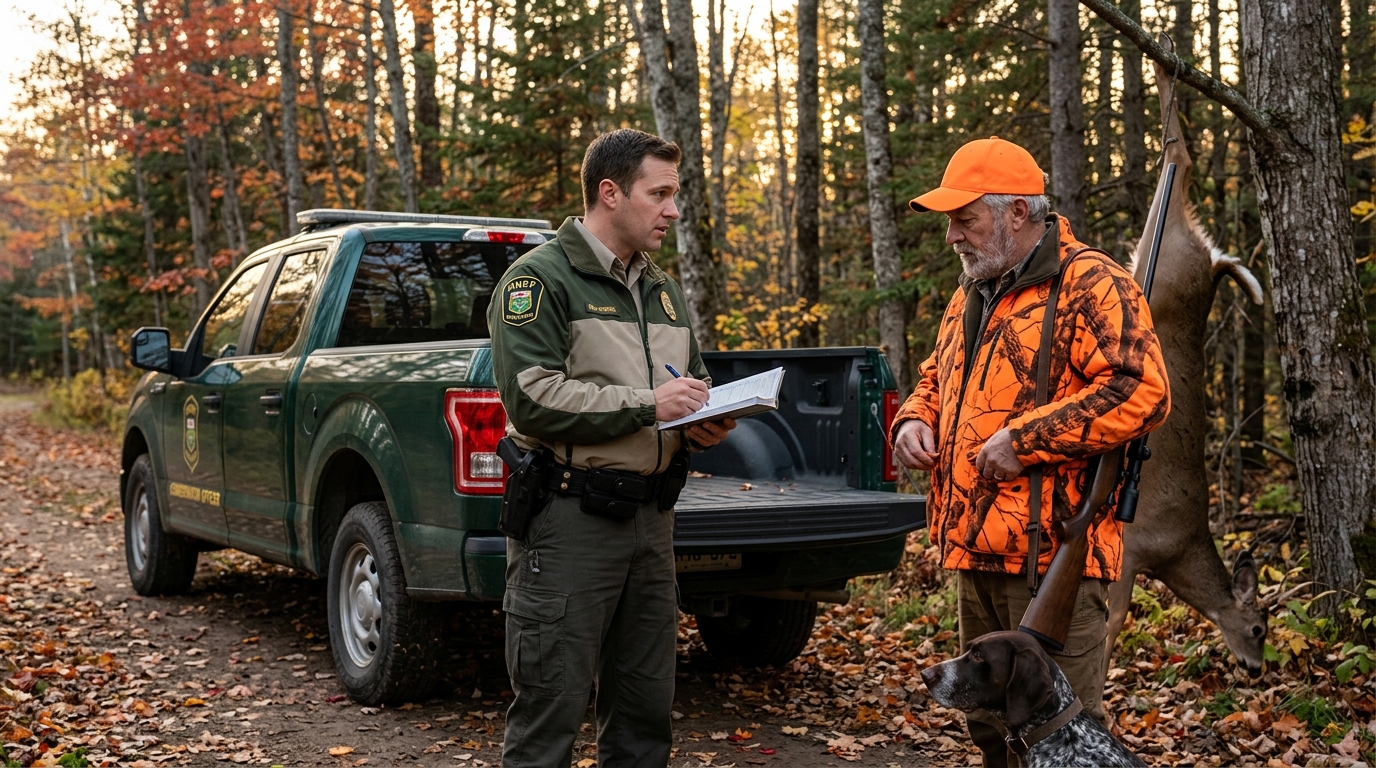
The first time a conservation officer walked up to my truck, I had everything right and still felt my stomach drop.
Highway 11, mid-October, a doe in the back. The officer checked my tag, my Outdoors Card, my licence, and asked which unit I hunted. Two minutes, all fine. Driving away, my partner asked what would have happened if my tag had been wrong. I gave him a confident number I had picked up somewhere online. That number was wrong by about $10,000, and it sent me down a long road of reading what Ontario actually charges.
Why Ontario Hunting Fines Come in Three Different Numbers
Search this topic and you get three answers that contradict each other, all technically correct. Hunters read the low number, plan around it, then get blindsided when a real case hits the news at twenty times that amount.
Here’s what each of the three numbers actually means:
The set fine, or what the ticket says
When a conservation officer issues a provincial offence notice for a straightforward violation, the amount comes from a published schedule. Those set fines sit low on purpose, since they cover routine matters resolved without a trial. A hunter who pays a set fine and moves on faces a few hundred dollars, not a few thousand.
The statutory maximum under the Act
Section 102 of the Fish and Wildlife Conservation Act, 1997 allows a fine of up to $25,000, imprisonment for up to one year, or both, for an individual convicted of an offence. Corporations face up to $100,000. Careless hunting carries its own exposure, with penalties reaching $25,000 or up to two years in jail, and the Criminal Code can apply on top.
What courts actually order
Between those two figures sits reality. Ontario justices of the peace weigh the species, the harm, the hunter’s honesty, and the number of charges. Serious moose cases land in the five-figure range, and the province publicizes them in court bulletins so other hunters see the cost.
Ontario Set Fines by Offence
The Ontario Court of Justice publishes a set fine schedule covering 288 separate offences under the Act. Most hunters have never seen it, and it answers the question they actually ask, which is what a specific mistake costs on a ticket.
Here’s what the current schedule lists for the offences hunters hit most:
| Offence | Set fine |
| Fail to wear proper coloured clothing while hunting | $300 |
| Trespass for the purpose of hunting | $200 |
| Resident, hunt big game without licence | $500 |
| Non-resident, hunt big game without licence | $600 |
| Unlawfully have loaded firearm in conveyance | $500 |
| Unlawfully discharge firearm in travelled roadway | $500 |
| Use firearm carelessly to hunt | $300 |
| Unlawfully hunt at night | $250 |
| Hunt big game that is swimming | $250 |
| Use boat to kill, injure, harass wildlife | $250 |
| Possess illegally killed wildlife | $200 |
| Transport wildlife unlawfully killed, captured or possessed | $200 |
| Hunt without having licence on your person | $200 |
| Make a false statement in a document | $400 |
| Fail to comply with wildlife disease control and surveillance zone order | $750 |
Amounts come from the Ontario Court of Justice set fine schedule for the Fish and Wildlife Conservation Act, last updated April 23, 2026.
The offences carrying the highest set fines
Disease control violations top the list at $750, which reflects how seriously the province treats chronic wasting disease containment. Firearm offences involving vehicles and roadways sit at $500, as does hunting big game without a licence and using another person’s licence.
Offences with no set fine, where court is mandatory
Several offences carry the notation N.S.F., meaning no set fine exists and the matter goes to court. Making a false statement to a conservation officer, obstructing an officer, and unlawfully using an aircraft while hunting all fall in this category, which exposes you to the full statutory maximum.
Ontario Moose Hunting Fines: What Real Cases Cost
Moose generates the heaviest enforcement in Ontario, and the court bulletins show why hunters should not plan around ticket amounts. These are real outcomes from recent Ontario Court of Justice decisions.
Here’s what moose offences have actually cost hunters:
Hunting moose without a licence
A Toronto man pleaded guilty to unlawfully hunting a cow moose without a licence and paid $5,000. A man from Richmond Hill pleaded guilty to trespassing for the purpose of hunting plus hunting moose without a licence, paid $7,000, and lost his hunting privileges for a year. A Wisconsin man found guilty of discharging a firearm down a roadway, hunting moose without a licence, and possessing illegally killed wildlife paid $28,750 and received a ten-year Ontario ban.
Party hunting and tag violations
Four hunters stopped on Highway 11/17 near Kakabeka Falls paid $8,000 between them after officers determined a cow moose taken in WMU 15B was harvested without following party hunting rules. In a separate northwestern Ontario case, one hunter paid $2,000 with a two-year suspension purely for invalidating his tag. Our guide to how the Ontario moose draw and tag system works covers the party and validation rules these cases turned on.
Careless or unlawful discharge while moose hunting
A southern Ontario man who carelessly discharged a firearm while moose hunting paid $7,000 and received a five-year ban. A Mississauga man who fired at a bull moose from a motorboat on the Otoskwin River paid $20,000 with a three-year suspension. Verifying your unit before opening day prevents a related class of charge, and our breakdown of Ontario hunting zones and how to find your WMU walks through that check.
The Penalties That Cost More Than the Fine
Most hunters focus on the dollar figure. Ask anyone who has been through it and they will tell you the money hurt less than losing seasons.
Here’s what the courts add on top of the fine:
Licence suspensions from one year to life
Suspensions scale with severity. False statements to officers have drawn one-year suspensions, tag invalidation two years, firing from a boat three years, careless discharge five years, and the Wisconsin roadway case ten years. Ontario has also handed down lifetime bans in its worst moose files.
Mandatory retraining before you reapply
Courts frequently order hunters to complete the Ontario Hunter Education Course and the Canadian Firearms Safety Course again before applying for any new licence. That order applies after the suspension expires, so the clock does not start until you finish the coursework.
Seizure of meat, firearms, and vehicles
Conservation officers may seize wildlife, meat, tags, licences, firearms, bows, equipment, vehicles, phones, and GPS units where the legal requirements are met. Courts can order forfeiture on conviction, meaning the rifle never comes home.
The Add-Ons Most Hunters Never See Coming
Three mechanics quietly multiply the final number, and none of them appear in the fine amount a hunter reads in a headline.
Here’s what gets added to the total:
The victim surcharge on every conviction
Ontario applies a victim surcharge to provincial offence fines, calculated as a percentage of the fine itself. In the Pickle Lake case where five hunters paid $37,000 in fines, the surcharges added $9,250 on top, working out to a further 25 percent.
Fines stack per offence and per person
Courts fine each charge separately. In one case a hunter received $1,500 for discharging a firearm down a road, $1,000 for shooting a calf during the closed season, $1,000 for abandoning it, $1,000 for obstruction, and $750 for a false statement. Every member of a party faces charges individually.
Charges can arrive years after the hunt
Section 103 allows proceedings within two years of the day evidence first came to a conservation officer’s attention, and no later than three years after the offence. A 2022 moose hunt near Sturgeon Falls produced $11,300 in fines at a 2025 trial.
Hunt It Clean This Season
Nearly every case above traces back to something preventable, whether a tag nobody validated, a unit nobody confirmed, or an orange vest left in the truck. The paperwork side costs nothing, and the gear side is worth getting right once.
We run Victory Ridge Sports a Canadian hunting and target sports store in Barrie, Ontario, at 431 Bayview Drive. We stock rifles, shotguns, and rimfire across every action type, plus ammunition, optics, storage, and the compliance basics that keep you legal, including blaze orange vests, hats, and outerwear.
Most of the people behind our counter hunt the same units you do, so we talk through the practical side before the sale. Visit the Barrie showroom Monday through Saturday, call 1-705-252-4400, or order online with free shipping over $250.
Frequently Asked Questions
These come up constantly, and the answers surprise people.
Here are the questions hunters ask us most:
What is the maximum fine for illegal hunting in Ontario?
Section 102 of the Fish and Wildlife Conservation Act, 1997 sets a maximum of $25,000, up to one year in jail, or both, for an individual. Corporations face up to $100,000. Careless hunting can reach $25,000 or two years, and Criminal Code charges may apply separately.
How much is the fine for not wearing hunter orange in Ontario?
The set fine for failing to wear proper coloured clothing while hunting is $300. That figure applies to a ticket resolved without trial. Where the charge accompanies other offences in a contested case, a court can impose considerably more.
Can you lose your hunting licence permanently in Ontario?
Yes. Ontario courts have imposed suspensions ranging from one year to ten years, and lifetime bans in the most serious moose files. Courts also order hunters to redo the Ontario Hunter Education Course and the Canadian Firearms Safety Course before reapplying.
Do Ontario hunting fines apply to non-residents?
They do, and non-residents pay higher set fines for licensing offences, $600 versus $500 for hunting big game without a licence. A suspension bars you from hunting anywhere in Ontario for its full term regardless of where you live.