My second season, I nearly cooked myself over a gravel road.I had permission on a bush lot north of Coldwater, and the back corner dropped into a cedar swamp that held deer all fall. Opening morning, I crossed a beat-up township road I had crossed forty times scouting and set up on the swamp edge. Around ten, my partner texted asking what unit I was in, because his tag did not cover the far side of that road. The road was the WMU line. My seasons matched, so I got lucky.
In this blog post we will explain Ontario hunting zones and how to find yours.
What Is a Wildlife Management Unit in Ontario?
A WMU works as a rulebook attached to a piece of ground. Two hunters standing 400 metres apart can face different seasons, weapon rules, and tag requirements, purely because a creek runs between them.
Here’s what a WMU controls, why Ontario built it this way, and why the unit count looks different depending on where you check:
The three things a WMU controls
Ontario’s Ministry of Natural Resources ties three variables to every unit: the game you can hunt there, the open season dates, and the hunting methods permitted. That triad decides whether your morning counts as a legal hunt or an offence under the Fish and Wildlife Conservation Act, 1997. Your licence proves you may hunt in Ontario, while your WMU decides what it unlocks.
Why Ontario manages by zone instead of province-wide
Wildlife does not spread evenly across a province stretching from Windsor to Hudson Bay. A whitetail herd in Chatham-Kent farmland lives at a density boreal deer near Sioux Lookout never reach. Biologists set harvest levels against local data, so one province-wide season would either overharvest thin areas or waste opportunity in dense ones.
95 or 151: why the WMU count depends on how you count
Search this and you will find two numbers, both from real sources. The province states Ontario contains 95 wildlife management units, while several hunting apps list more than 150. Ontario numbers 95 units, then splits many into lettered sub-units with their own boundaries and regulations. Unit 1 breaks into 1A through 1D, and 69A splits again into 69A1, 69A2, and 69A3. Always quote your unit with the letter attached.
How to Find Your WMU (5 Methods, Ranked)
Five methods work, and they suit different moments. One belongs on your kitchen table in August. Another belongs in your pack in November, when your phone sits at 4 percent and the boundary runs through the swamp in front of you.
Here’s how to pin down your unit, ranked from most authoritative to most convenient:
- Official regional and per-unit maps. The province’s Find a wildlife management unit (WMU) map page hosts three regional overviews plus a PDF for every unit and sub-unit.
- The printable letter-sized unit map. Print the sheet for your unit and the units next door, then fold it into your pack.
- A GPS app with a WMU overlay. iHunter, HuntScout, Gaia GPS, and Avenza render boundaries over satellite imagery and drop your live position on the map, with offline caching.
- Address or postal code lookup. Third-party tools resolve a civic address to a unit number, useful for a farm you have never visited.
- A call to the local ministry work centre. The Ontario Hunting Regulations Summary lists the office administering each unit.
The one method that works with no signal
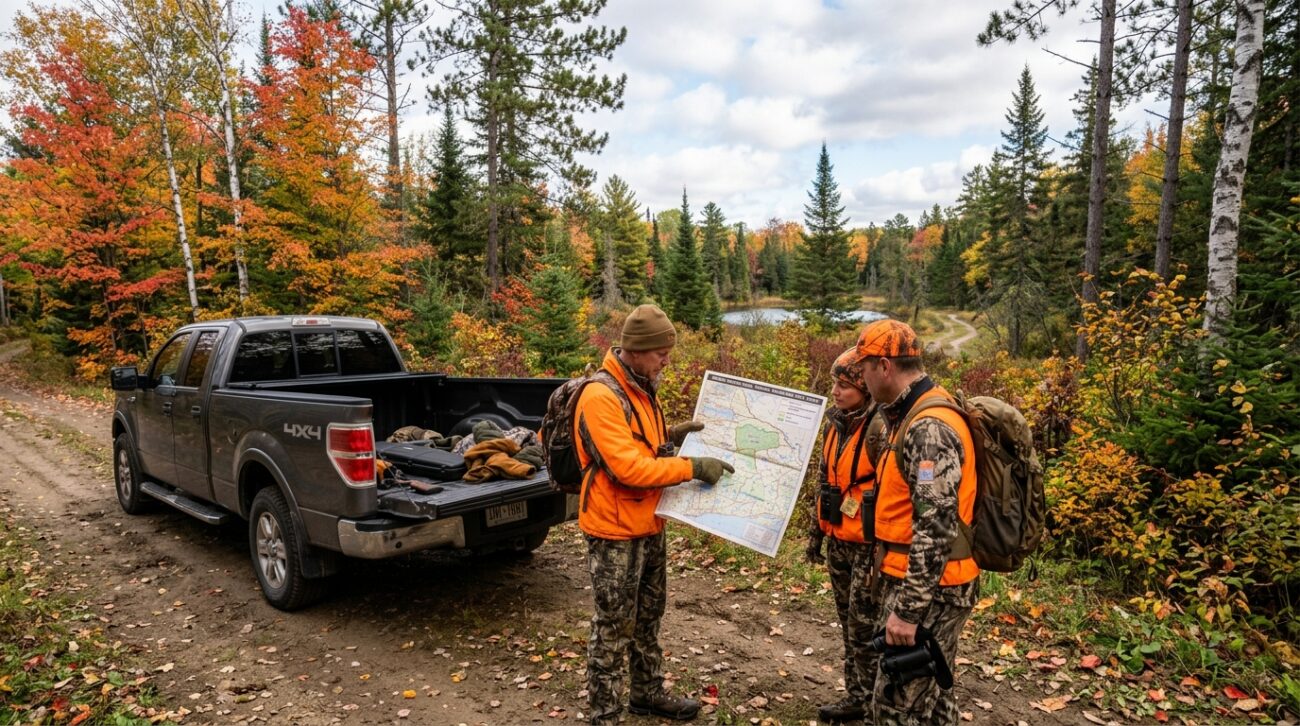
Paper does not run out of charge, lose satellite lock, or fail in minus twenty. Ontario’s own advice for hunting near a boundary runs simple: print the letter-sized map and carry it. Two sheets weigh nothing and survive a wet November better than most phones.
Verifying a boundary you’re not sure about
Boundaries follow physical features wherever possible, meaning roads, rivers, shorelines, and rail lines. That helps in the field and creates ambiguity in the places you care about, since rivers braid and old rail beds vanish into second growth. When you cannot tell which side you are on, ask the ministry office for a ruling.
Why Your WMU Matters More Than You Think
Hunters treat the unit number as a formality on the licence summary. It actually works as the index key to Ontario’s whole regulatory system, since season dates, weapon rules, tag eligibility, and your harvest report all resolve through that number.
Here are the three that catch hunters most often:
Seasons split by weapon
A single species in a single unit often carries three or four distinct seasons, each tied to a weapon class. Deer across much of central Ontario runs a gun season, a muzzleloader season, and bows-only windows. Cross into the next unit and the gun season may open earlier, close later, or drop a weapon class.
Tags, draws, and allocation run unit by unit
Your licence alone does not always put you in the woods. Moose runs on a points-based tag allocation tied to specific units, elk runs a resident-only draw around Bancroft and North Hastings, and antlerless deer runs on validations. Our breakdown of how the Ontario moose draw and tag system works covers the process and the deadlines behind it.
Your mandatory report is filed by WMU
Ontario requires hunter reports for elk, deer, bear, turkey, wolf, and coyote where a tag applies, and for every hunter issued a moose licence, even those who never hunted. Those reports feed the estimates that set next year’s quotas in that same unit, and a surcharge now applies to repeated failures to report.
Your WMU Tells You When, Not Where
This one misunderstanding causes more wasted drives than any other. Your unit says nothing about whether you may legally set foot on the ground in front of you, because Ontario stacks separate permission systems on top of the unit map.
Here are the three layers that decide where you may legally stand:
Crown land, private land, and patented land
Ontario Crown land generally opens to licensed hunting and makes up most huntable acreage north of the French River. Private land requires landowner permission, and an open season changes nothing about that. Parks, conservation reserves, and federal lands each carry their own rules.
Municipal bylaws on discharge, feeding, and dogs
Ontario municipalities may pass bylaws restricting hunting inside their boundaries, and the province flags three categories: the discharge of firearms, the feeding of wildlife, and the use of dogs. A township can prohibit firearm discharge near dwellings while the provincial season stays wide open.
Sunday gun hunting is not province-wide
South of the French and Mattawa rivers, provincial regulations permit Sunday gun hunting in some municipalities and not others. Ontario publishes the list of participating municipalities, and hunters who assume a blanket rule either lose a legal day or take an illegal one.
Zone-Specific Rules to Check for the 2026 Season
Some obligations attach to a short list of unit numbers and change from year to year, which makes them easy to miss even for hunters who read the summary carefully.
Here’s what applies this fall:
CWD monitoring WMUs
Ontario runs chronic wasting disease surveillance in two regions for 2026. Southern Ontario covers WMUs 79C, 79D, 87C, 87D, 87E, 88, 89A, 89B, and 90A. Eastern Ontario covers WMUs 63B, 64A, 66A, 67, and 69B. The first 500 hunters in each area who submit a sample receive a participation crest, and submitting does not affect eating the meat.
Bait and feed restrictions
Ontario permits only synthetic or plant-based bait and feed products, and the province asks hunters not to bring bait in from outside Ontario, since imported product can carry chronic wasting disease into a jurisdiction that has stayed clean. Bear hunters feel this most directly, and our complete guide to planning bear season in Ontario covers how baiting works across both windows.
Getting Set for Your Unit
Sorting out your WMU costs you nothing but a few minutes. Everything after that, the boots that survive a wet November sit and the optics that pick a bedded deer out of grey cedar, comes down to gear that matches the country you drew.
Victory Ridge Sports is a Canadian hunting and target sports store in Barrie, Ontario, at 431 Bayview Drive, where Simcoe County farmland gives way to Shield bush. We stock rifles, shotguns, and rimfire across every action type, plus ammunition, optics, storage, hunting apparel, footwear, packs, knives, and calls. We also carry one of the better in-store Sitka Gear inventories in Ontario, plus Vortex, Holosun, Maple Ridge Armoury, and Canuck.
Most of the people behind our counter hunt the same units you do, so the conversation starts with where you are going rather than what sits on sale. A shotgun-only unit in the southwest calls for different glass than a rifle unit north of Parry Sound. Visit the Barrie showroom Monday through Saturday, call 1-705-252-4400, or order online with free shipping over $250.
Frequently Asked Questions
How many hunting zones are in Ontario?
Ontario divides the province into 95 wildlife management units. Many split further into lettered sub-units such as 1A through 1D or 76A through 76E, each with its own regulations. Counting every distinct mapped sub-unit brings the total past 150, which explains why sources quote different numbers.
How do I know what WMU I’m in?
Open the province’s WMU map hub and download either the regional overview or the individual PDF for your unit. For live positioning, use a hunting app with a WMU overlay and offline map caching. When you hunt near a line, print the letter-sized map and carry it.
Can I hunt the same tag in two different WMUs?
That depends entirely on the tag. Some Ontario tags and validations apply to one unit or a defined group of units, while others carry broader coverage. Read the unit conditions printed on your tag and licence summary, and never assume a tag travels with you.
What’s the difference between a WMU and Crown land?
A WMU tells you what you may hunt and when, while land status tells you where you may legally stand. Crown land generally allows licensed hunting, private land requires permission, and some parks and federal lands prohibit it entirely. Municipal bylaws apply on top of both.